The Hardest Problem AI Ever Solved: Demis Hassabis on What He's Really Building
Cleo Abram interviews Google DeepMind CEO Demis Hassabis using a Jenga tower where each block is a project. Across 65 minutes Hassabis walks through what AI is doing beyond chatbots, how systems learned to be creative, the two failure modes he thinks are underweighted, and the abundance future he believes is roughly 50 years out.
Watch on YouTubeThe 90-second version
- Hassabis argues AI's largest impact is mostly invisible — drug design, genomics, natural-disaster detection, fusion, materials — not the chatbots people interact with.
- AlphaFold solved the 50-year protein-folding problem. Rather than run a request server, DeepMind folded ~200M known proteins and released them free. Over 3M scientists now use it; it spun out Isomorphic Labs, now running 18–19 drug programs.
- AlphaGo's move 37 against Lee Sedol in 2016 showed a system could play beyond human knowledge. AlphaZero then reached superhuman play from rules alone via self-play — an approach Hassabis thinks is returning, layered on today's foundation models.
- He weights two risks above the rest: bad actors repurposing the tools, and increasingly autonomous "agentic" systems breaching their guardrails. Both, he says, are underweighted even by experts; deepfakes are real but narrower and nearer-term.
- The optimistic case: AI cracks "root-node" problems like fusion and superconductors, which unlock near-free energy, space travel, and cures — "maximum human flourishing," plausibly within 50 years if the AGI transition goes safely.
01 · The interview
The part of AI you don't see
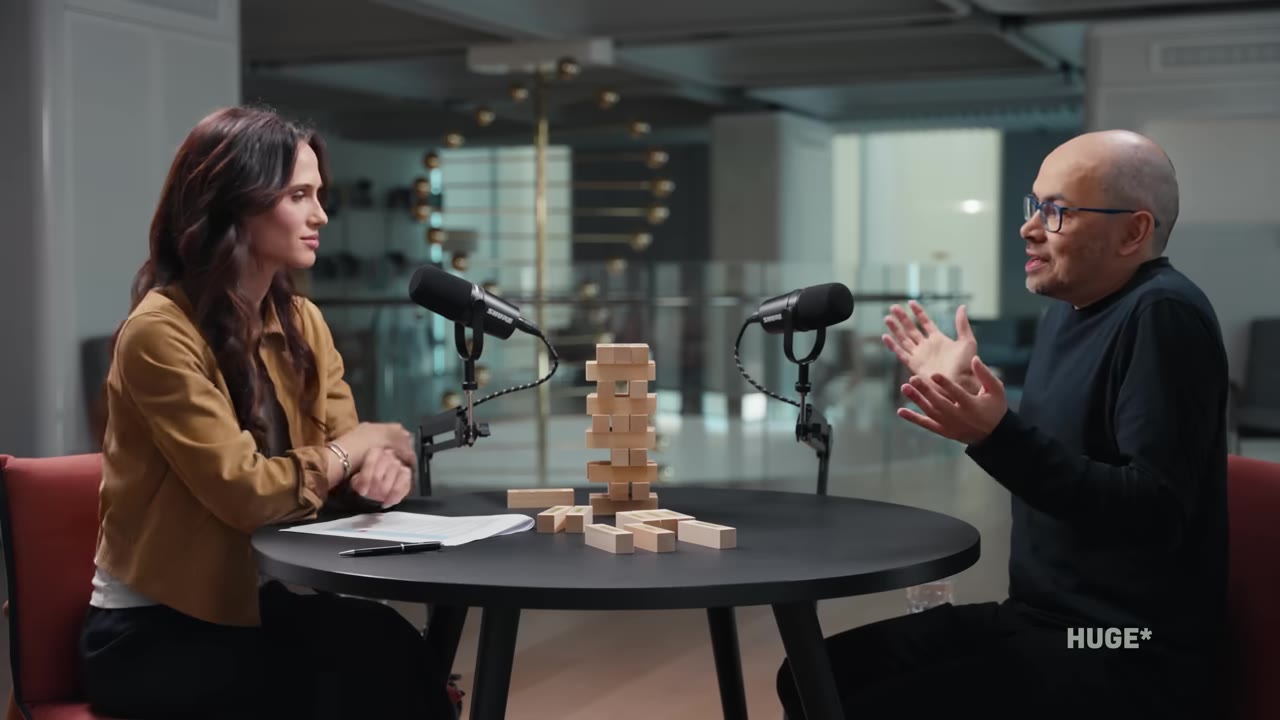
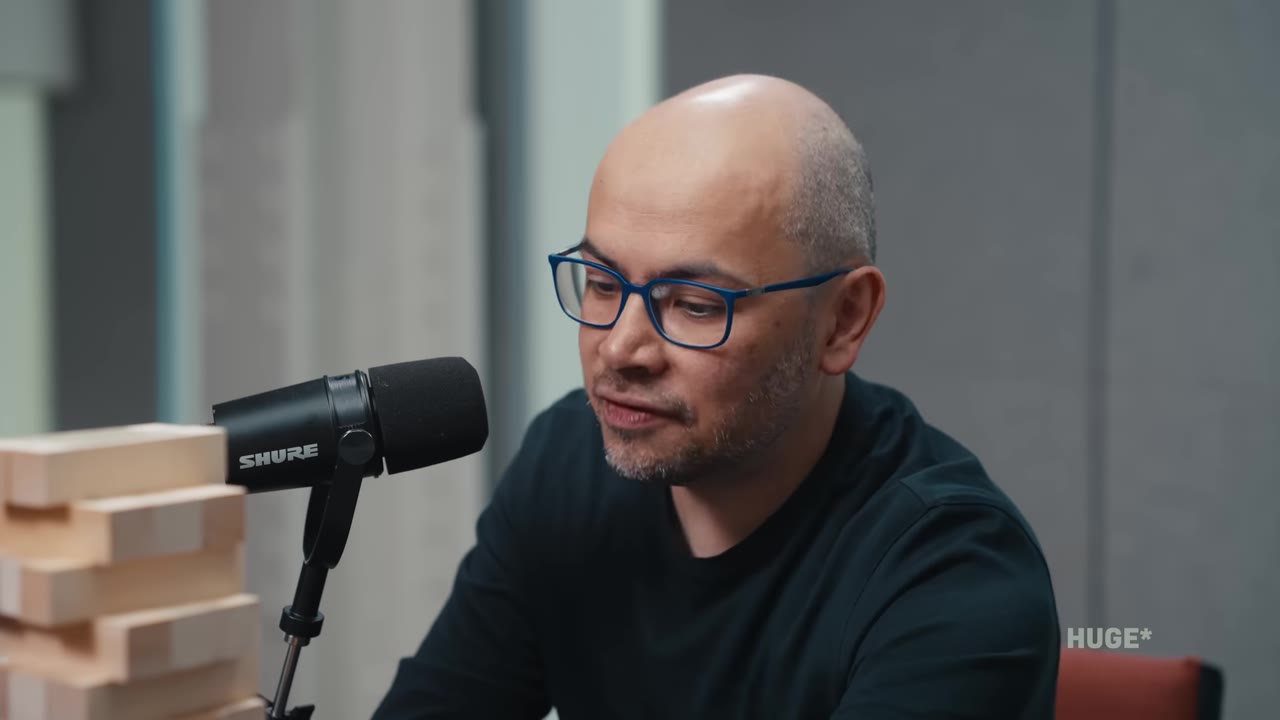
The interview is built around a Jenga tower where each block is a DeepMind project — a prop Cleo Abram brought as a visual aid for a live explainer. There are more of these projects than most people realize, and Hassabis argues the ones shaping people's lives most are not the visible ones.
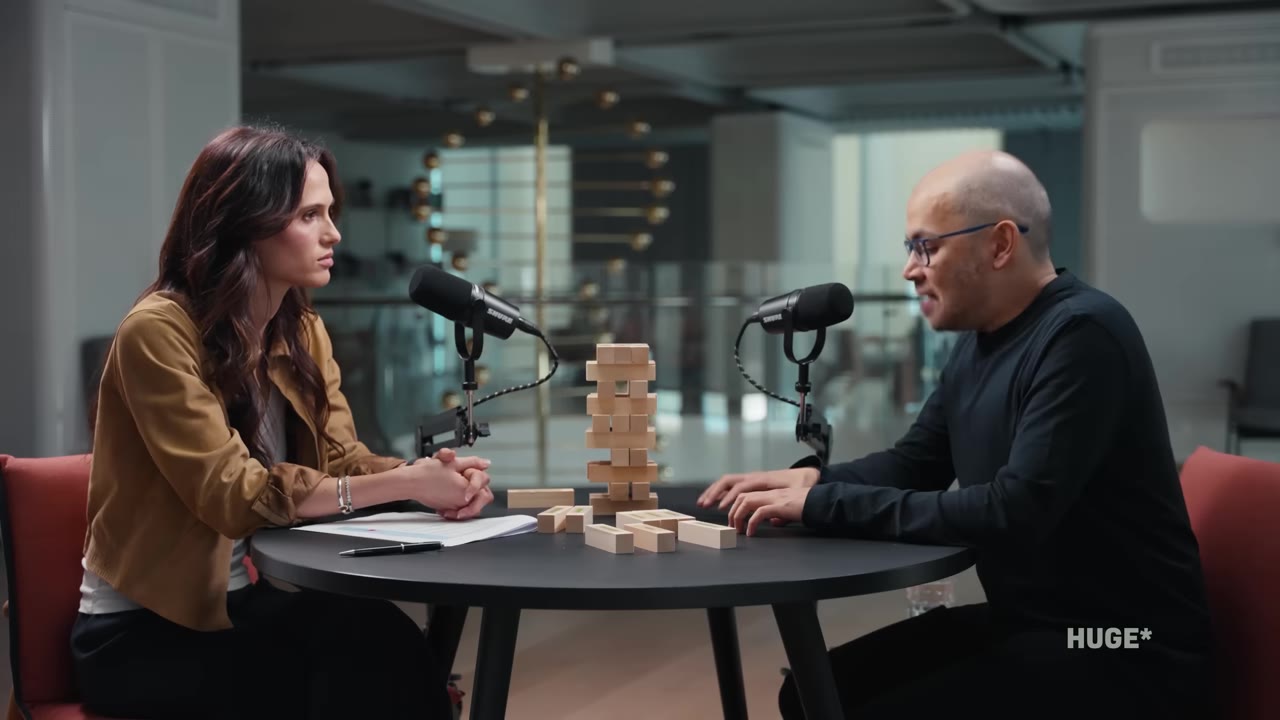
The ways in which AI is meaningfully shaping people's lives most are the things that are invisible to them most of the time.— Demis Hassabis
The work he means sits underneath the products: drug design, genomics, natural-disaster detection, nuclear fusion, materials, quantum computing. Tools, not chatbots.
02 · Project: AlphaFold
A 50-year problem, then released for free
A protein's 3D shape partially determines its function, and predicting that shape from the one-dimensional amino-acid sequence was the 50-year grand challenge of protein folding — described to Hassabis as the equivalent of Fermat's Last Theorem for biology. The old route was to shoot X-rays at a single protein, at a cost of years and hundreds of thousands of dollars.
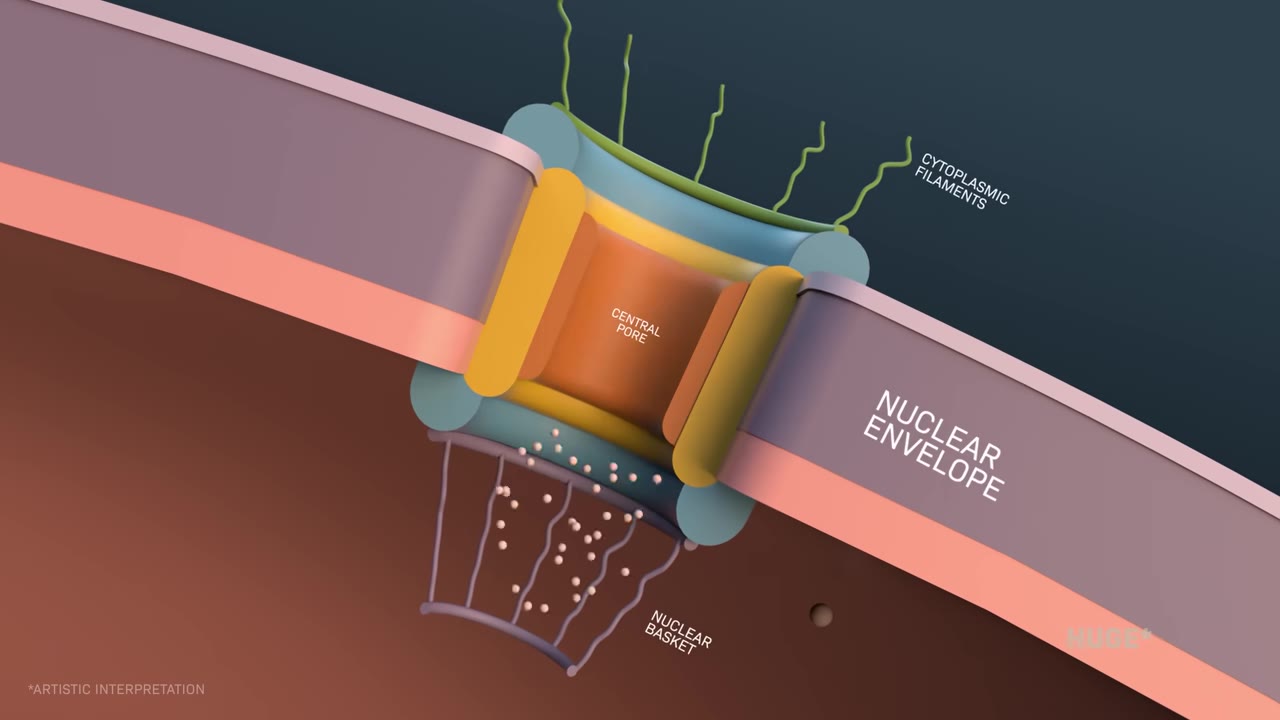
The decision came in a 2021 meeting that happened to be filmed. The plan was to stand up a server where scientists request one protein at a time. Doing the back-of-the-envelope math on his phone, Hassabis realized that folding all ~200 million known proteins would take about a year — and be less effort than building the server.
We should just run every protein in existence. And then release that.— Demis Hassabis
They folded them all and put them in a free public database, updated each year as new sequences come in. Over 3 million scientists now use AlphaFold; a scientist at a pharma company told Hassabis that nearly every drug developed from now on will probably have used it somewhere in the process.
03 · Project: Isomorphic
Designing drugs in silico
Knowing a protein's structure is only one small part of drug discovery. Isomorphic Labs builds the adjacent systems — "AlphaFold 3, AlphaFold 4, you could call it" — to design a chemical compound that binds strongly to the right spot on the protein, and crucially does not bind to the other 20,000 proteins in the body, which is what produces toxicity.
04 · Project: AlphaGenome
Reading the noncoding 98%
CRISPR can now target nearly any DNA sequence, but for most genetic diseases we still don't know which change in the DNA is actually driving the problem — especially in the 98% of the genome that doesn't code for proteins.
AlphaGenome, which DeepMind just released, takes long genetic sequences and predicts whether a mutation at a single position is harmful or benign — the best system in the world at this, Hassabis says, though not yet accurate enough for the hard multigenic cases where cascades of mutations cause disease. A future version paired with CRISPR could find the mutation and then fix it.
05 · The turn
"I'd have left AI in the lab longer"
Hassabis founded DeepMind to solve intelligence and apply it to science, and sold to Google for the freedom to do exactly that. Then ChatGPT shipped, Google went code red, and he became head of all of Google's AI, including the consumer products. His preferred path, he says, would have been slower and more careful — a CERN-like effort, understanding each step on the way to AGI, even if that took a decade or two longer.
He weighs both sides. The race means everyone gets to use AI only three to six months behind the labs, which helps society normalize to the change incrementally; and millions of users stress-test systems in ways no in-house testing can. But it's a ferocious commercial pressure, layered on the US–China geopolitical race. Language turned out to be far easier than expected — transformers, which his Google colleagues invented, plus some reinforcement learning on top, were enough.
06 · How it works
Two kinds of AI: learn from data, or learn from rules
The conversation keeps returning to a split. One family of systems is given a large amount of data and asked to make predictions, like AlphaFold. The other is given only the rules — math, physics, games like Go — and has room to be creative within them.
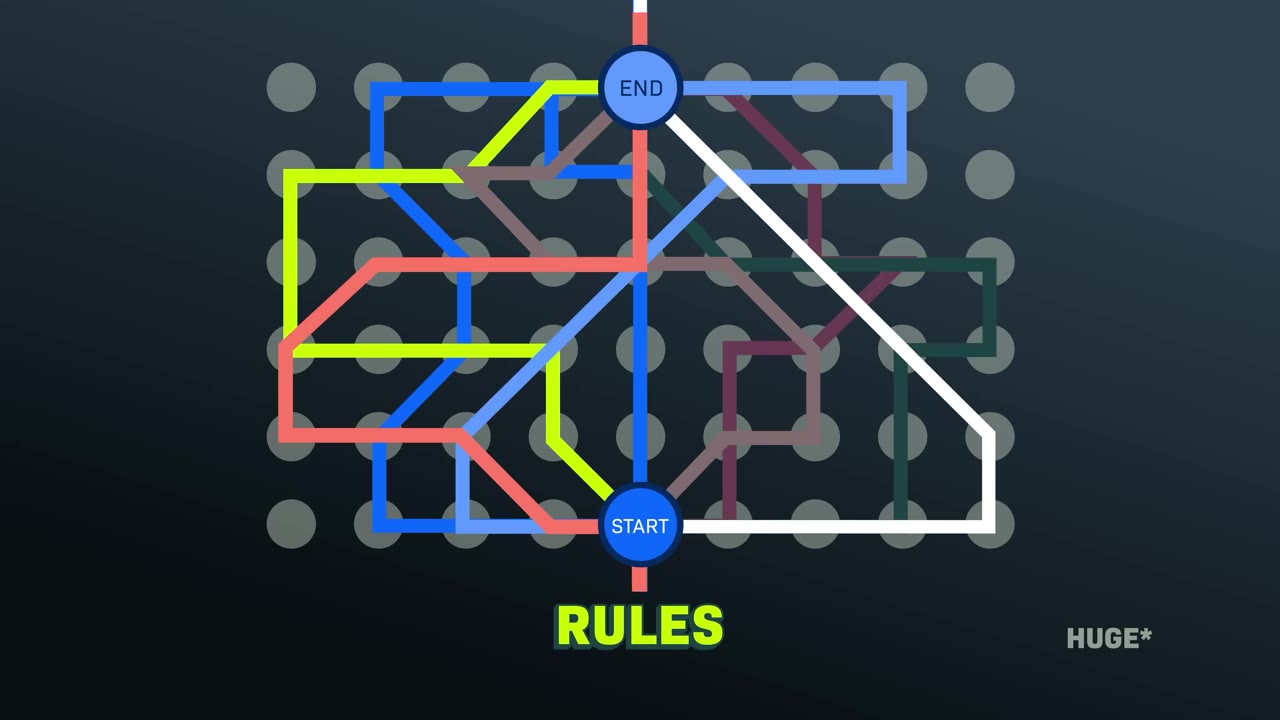
The earlier game-playing systems, like Deep Blue beating Garry Kasparov at chess, were expert systems: grandmaster knowledge distilled into rules and run as a brute-force search. Hassabis found that unsatisfying — Deep Blue couldn't even play a strictly simpler game like tic-tac-toe.
Something's obviously not quite right about the definition of intelligence — Deep Blue can't even play tic-tac-toe. The intelligence wasn't in the system; it was in the minds of the programmers.— Demis Hassabis
07 · The creative leap
Move 37
Go has more board positions (10^170) than there are atoms in the universe, so it can't be brute-forced, and its moves rest on intuition that's hard to encode as rules. AlphaGo learned from human games on the internet and overlaid a tree search to go beyond them. In March 2016 it beat Lee Sedol 4–1, watched by 200 million people. In game two it played move 37, on the fifth line early in the game — the kind of move a Go teacher would slap your wrist for — and it turned out to be the move that won, 100-plus moves later.
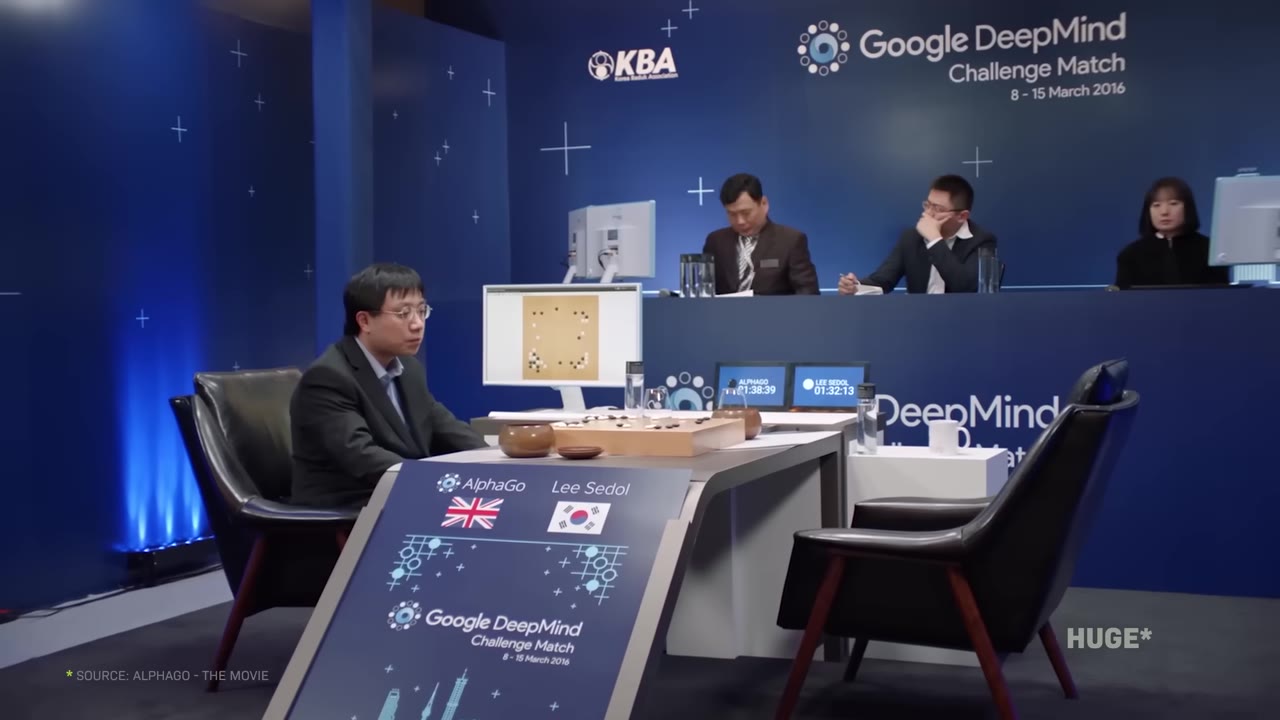
AlphaZero then removed the human data and any Go-specific assumptions, starting from the rules alone — tabula rasa — and learning by playing itself. Around 16–17 generations took it from random to better than the world champion:
It starts in the morning random… by tea time it's better than all grandmasters, and by dinner time it's better than the world champion.— Demis Hassabis
Hassabis thinks these search-and-self-play ideas need to come back, layered on top of today's foundation models as "world models" — and applied to science. AlphaTensor found a faster matrix-multiplication algorithm; AlphaChip designs chip layouts that beat human designers in some cases.
08 · The worry
Two things to worry about
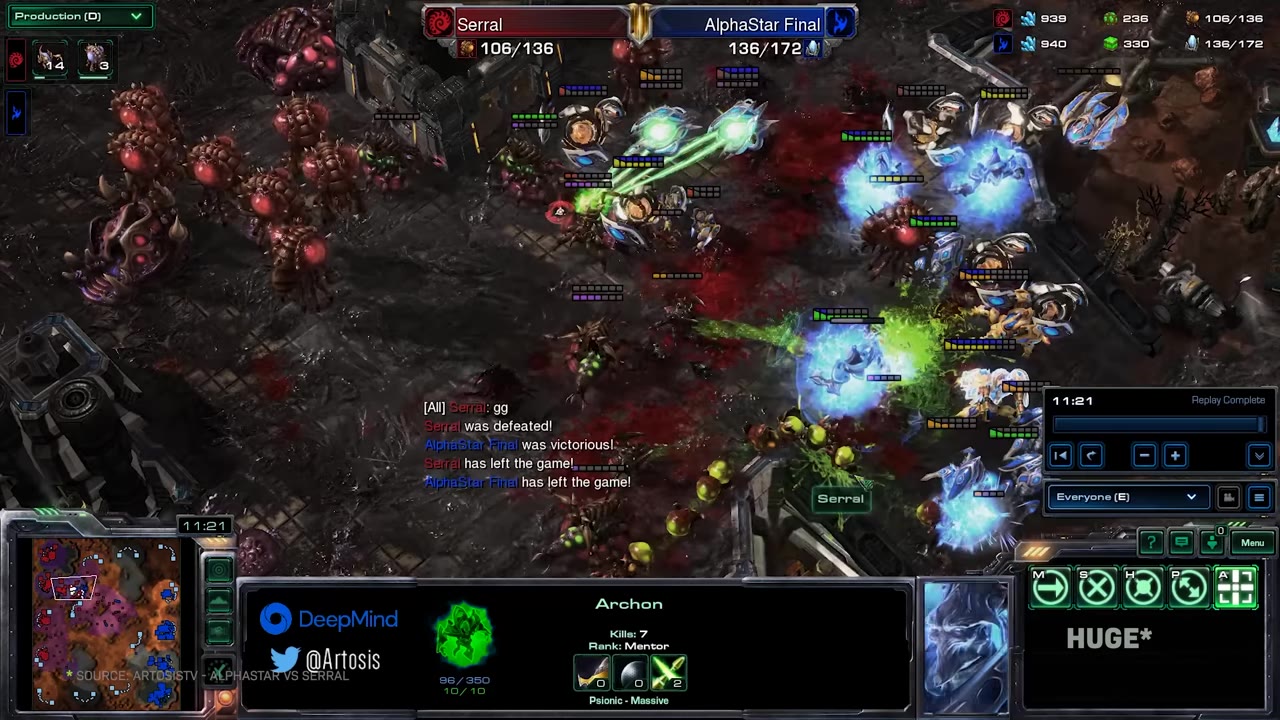
Cleo adds a block: a real-time strategy game where the system crushes humans and the engineers cheer. It sets up the harder question — governments are going to use AI, and Hassabis thinks people get bogged down in the details and miss the big picture. He'd want governments to use it for public health, education, and optimizing energy grids (DeepMind cut data-center cooling energy by 30% this way). But these are dual-use technologies, and two failure modes concern him most.
- Bad actorsindividuals up to nation-states repurposing tools built for curing disease and advancing energy toward harmful ends — inadvertently or intentionally.
- AI going off the railsas systems become more autonomous in the agentic era now beginning, keeping them inside their guardrails without circumventing or accidentally breaching them — an incredibly hard technical challenge as they get more capable.
He places both maybe three or four years out and thinks they're underweighted even by experts. Deepfakes and misinformation are real but nearer-term and narrower — DeepMind's SynthID watermarks generated media, and he'd like every generative-AI company to build in something similar. On the larger risks, he wants international cooperation among the frontier labs, the AI safety institutes, and academia.
09 · The big question
What can't a machine do?
Hassabis calls the limits of AI the central question of his life. Modern computers are Turing machines, able to compute anything computable, and he and many neuroscientists think the brain may be well modeled as an approximate Turing machine too. His friend Roger Penrose argues there may be quantum effects in the brain; so far neuroscience has looked carefully and hasn't found any.
If the brain is mostly classical computation, it's not clear what the limit would be on what AI could eventually do or mimic. Cleo names the move we keep making — looking for the reason humans are special, and watching each claim fall. Hassabis still thinks we're special, but is genuinely open-minded; he expects building an intelligent artifact to act as a controlled comparison that reveals what is actually unique about the mind. What he ultimately wants is to use AI to understand the nature of reality.
10 · The optimistic case
Root-node problems, free energy, and the stars
Asked to play out the sci-fi version of the future where this works, Hassabis points to Iain Banks' Culture series — a post-AGI world of abundance — and says some of it could arrive within 50 years if the AGI moment goes safely. The mechanism is what he calls root-node problems in the tree of knowledge: AlphaFold was one, and cracking each unlocks a whole branch of new research.
11 · The takeaway
Become superpowered, and a life of service
Asked how an optimistic viewer should participate, Hassabis is concrete: immerse yourself in every available tool and become superpowered with them. Even the frontier labs can only explore a fraction of the applications, and that capability overhang is widening as release schedules speed up.
A kid these days could probably start a multi-billion-dollar business using these tools in some new way that no one had thought about.— Demis Hassabis
Cleo's closing question — what he'd want said at his funeral — gets the simplest answer: "that my life was of benefit and service to humanity."