Inside Ramp: How a $32B Company Runs on AI Agents
Ramp shipped 500+ features and passed $1B in revenue with ~25 PMs, and runs about as AI-native as any company outside the big labs. CPO Jeff walks through the actual agents, tools, and org changes behind that — a Voice-of-Customer agent, PMs shipping production code, and where he thinks the PM role goes next.
Watch on YouTubeHow Ramp actually operates
- Ramp shipped 500+ features and passed $1B in revenue with ~25 PMs by going aggressively AI-native: ~50% of its code is AI-written (up from 30% in December, headed for 80%).
- The workflow flipped — PMs no longer write specs for engineers; the spec is a prompt and the output is a working product. PMs, designers, even sales ship real PRs via Ramp's internal 'Inspect' tool, a chunk auto-approved.
- Agents run the unglamorous work: a Voice-of-Customer agent sifts Gong calls, tickets, and Salesforce to surface problems (8 minutes vs 8 days); Ramp Research answers any data question (Snowflake CLI + Claude + custom skills).
- The leader's job shifts from 'best at the craft' to fixing the process: when output is wrong, ask which prompt/skill/design-system failed and fix that, so the feedback never recurs. Planning horizon: ~3 months.
- The PM role isn't dead but splits — become a builder (code is free) or own the business/GM side (strategy, positioning, monetization). 'Management is probably dead'; software becomes 'coworkers,' and the bar is being the best builder.
01 · The numbers
What the velocity looks like
Ramp shipped 500+ features last year, passed $1B in revenue, and did it with ~25 PMs. Peter calls it one of the fastest-growing companies ever and the most AI-native he knows outside the big labs.

50% of Ramp's code is built by AI. That's 50% up from 30% in December. It'll probably be 80% by March.— Jeff, CPO of Ramp
02 · Prompt to product
The spec is for the AI now
PMs used to pride themselves on the perfect spec. Now the AI reads the spec, not an engineer. So the spec is just the output of a prompt, and its output is the product — prompt to product, back to prompt, back to product.

We don't really talk about the spec itself — that's just a step. We talk about the actual product. It's prompt to product, back to prompt, back to product.— Jeff
03 · Voice of the customer
Sifting 50,000 customers' signal
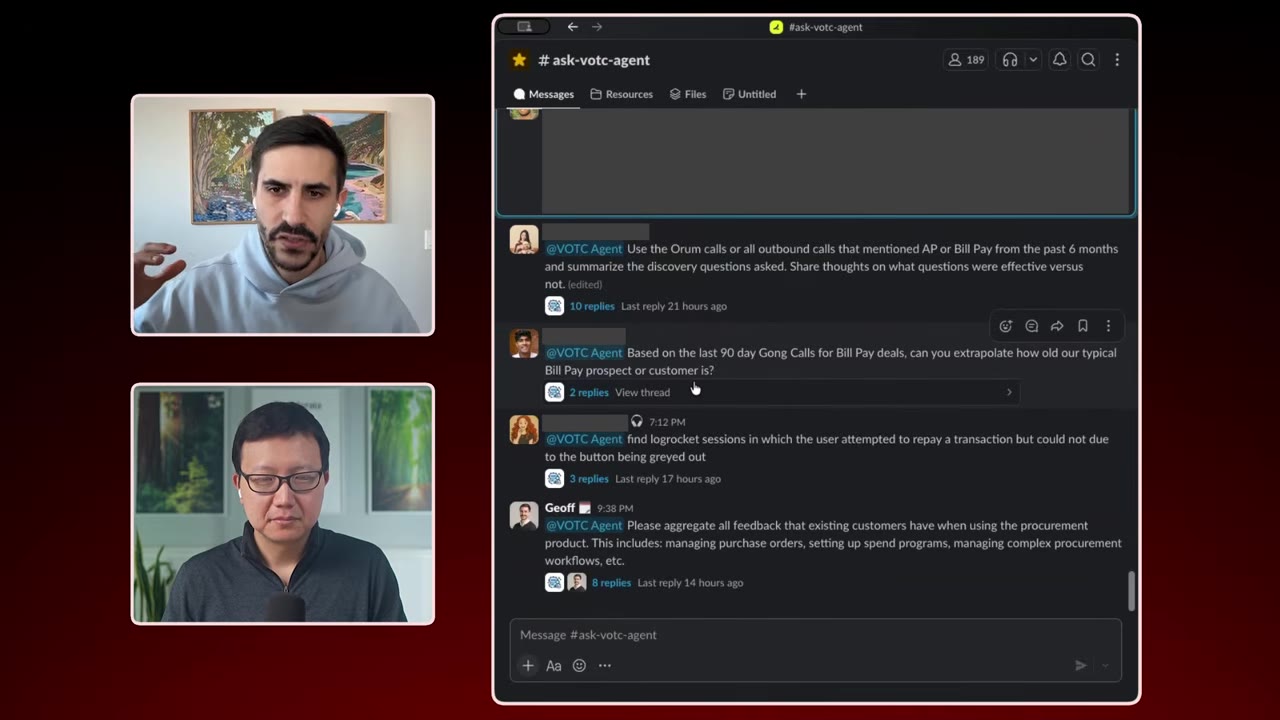
Ramp has 50,000+ customers and over a million end users, so the hard part is sifting the noise. The Voice-of-Customer agent — a job a person used to do by hand — reads Gong recordings, Salesforce notes, in-app surveys, support tickets, chats, and the Snowflake database, and answers any PM question about a persona's pain points and workflow gaps.
04 · Ramp Research
Anyone can query the data
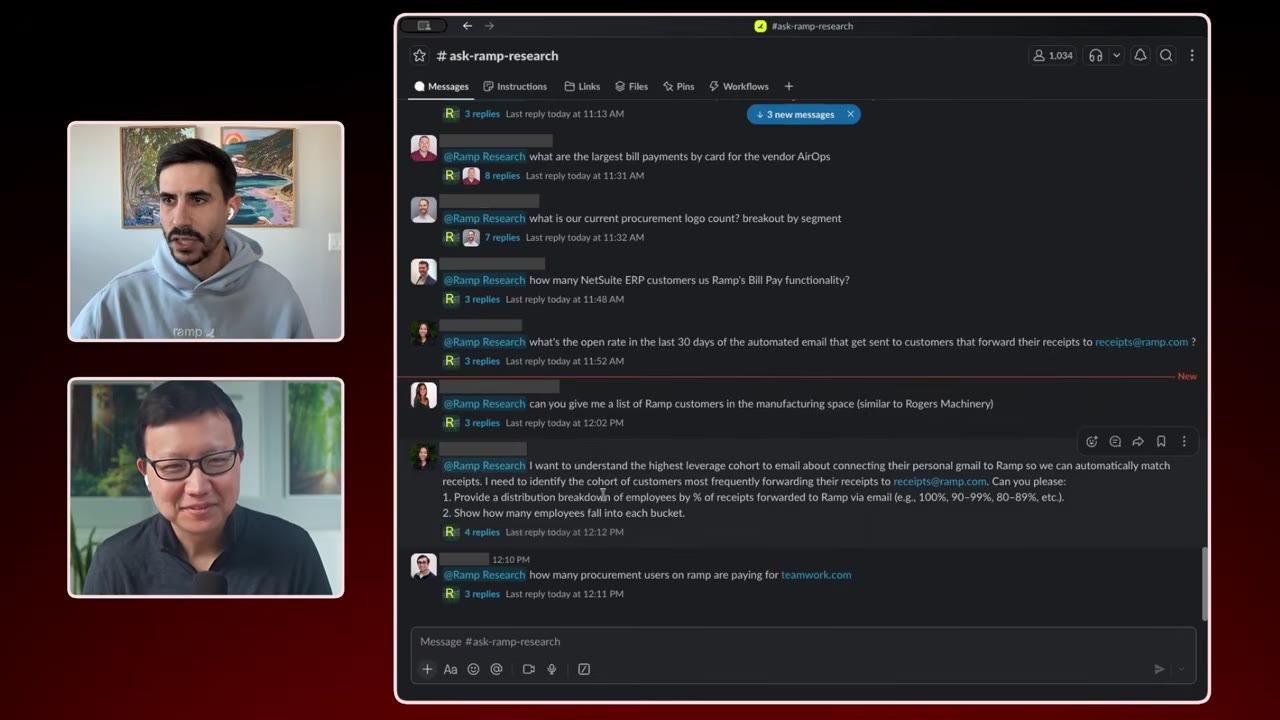
Making data easy to query got more people querying it, which made Ramp more data-centric as a company. Ramp Research understands the entire database and schemas and answers a question in about two minutes — open rate of automated emails, which customers are in Milwaukee, common use cases of a product. Sales, support, and marketers all use it. It's since moved to Snowflake CLI + Claude + custom skills.
05 · Inspect
Non-engineers ship real PRs
The problem was making code less intimidating for a non-builder. Ramp built Inspect, a visual layer on top of any LLM, with the design component library baked in so it doesn't have to be taught what a metric or module looks like. It does front-end and back-end, not just a front-end prototype.
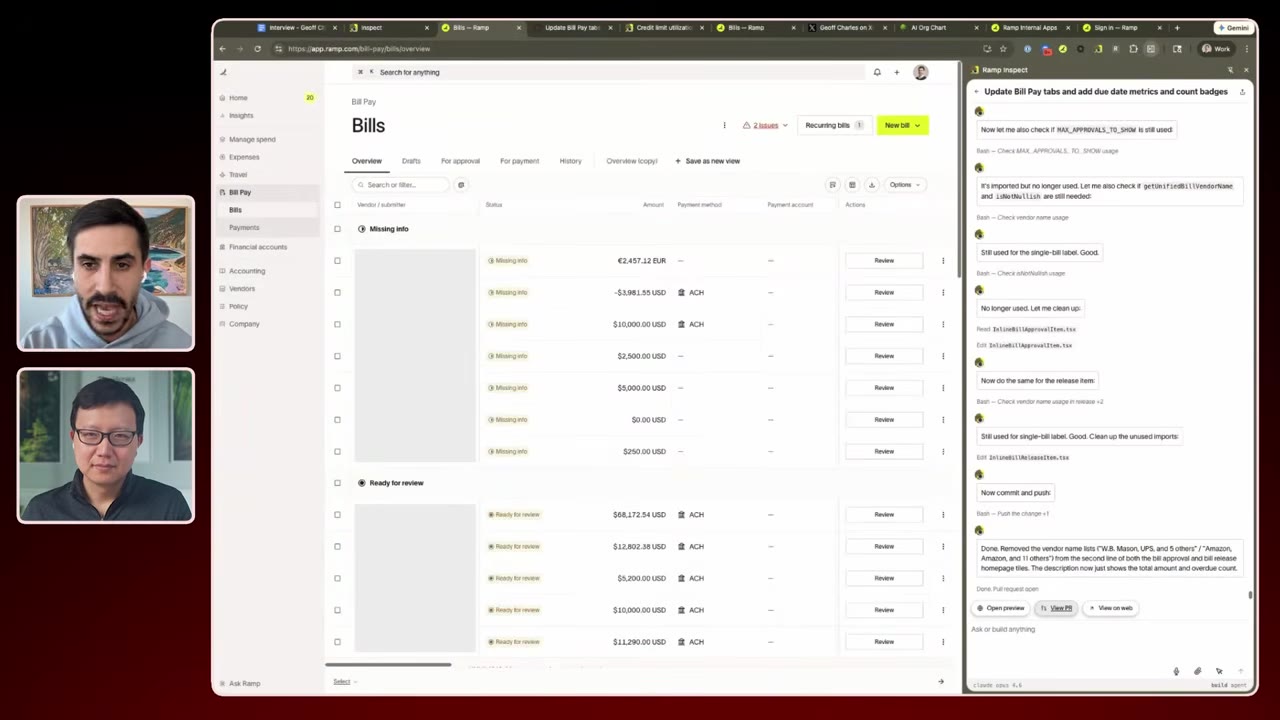
Feedback closes the loop. An escalation or a support ticket comes in; AI takes the first pass, figures out what happened and where in the codebase, opens the PR, and often ships it.
06 · The leader's job
Fix the process, not the output
Jeff still tests the product, checks it against customer feedback, and calls metrics not good enough. But when he sees a bad result, the higher-leverage question isn't how to fix it — it's what broke down in the process. Which prompt failed, which skill, which design system? Fixing the output for one person is a one-time bandaid; fix the process and you never get that feedback again.

Planning runs on a 3-month horizon — "within 3 months you can do what you used to do in 3 years." It's mostly three things: aligning on strategy and trade-offs, getting commitment from teams, and giving sales a baseline of what's coming (one-pagers and slides auto-generated in Ramp's branding). Not a roadmap.
07 · The PM role
It splits in two
When code got automated, people concluded it was over for PMs. Jeff's take is the opposite: it's more over for the engineer — an engineer now manages hundreds of thousands of agents. The old PM training — stakeholder management, prioritization, communication, frameworks — is outdated, because code is free. The role splits two ways.
- L0occasional ChatGPT user — "most likely won't be at the company."
- L1builds custom GPTs / Notion agents.
- L2built an app that automates part of their job; commits code.
- L3a systems builder who lifts everyone else up.
To move people up the ladder, Ramp removes the constraints — no limits on access, tokens, or budgets — sets the tools up well (MCPs, skills, an internal skills repository), runs public channels where people share what they built, plus office hours and designated experts to get people set up. AI proficiency is now a hard requirement to be hired; the product interview is build-a-product, walk me through why and how. And Ramp tracks per-person usage across Notion AI, ChatGPT, Claude Code, Claude Co-Worker, and Inspect to see who's pushing the bar and who needs a nudge.
08 · Software is dead
Build coworkers, not dashboards
Jeff isn't worried about cost. Token consumption per employee isn't close to double digits as a share of salary, and he argues it should be higher than your salary: if an agent does 10x your work, why wouldn't you pay it twice what you pay yourself? The investment in letting people discover is the competitive advantage — it's why Ramp raised money. What he's actually racing is the window before AI one-shots a whole platform like Ramp.

Management is probably dead… now is the time to be very, very proficient in this new technology. Optimize to be the best builder in the world.— Jeff