Why Let LLMs Predict 4 Tokens at Once? Multi-Token Prediction Explained
A non-reasoning model can't tell you how many words its next sentence will have — because predicting one token at a time, left to right, makes it bad at seeing its own future. Multi-token prediction asks the model to call the next few tokens at once. It sounds like it should make things worse; it mostly makes them better, and it's most of why DeepSeek V3 trains the way it does.
Watch on YouTubeMTP in one pass
- Next-token prediction's core flaw: one token at a time, left to right, so the model can't foresee its own output — it can't even tell you how many words its next sentence will have.
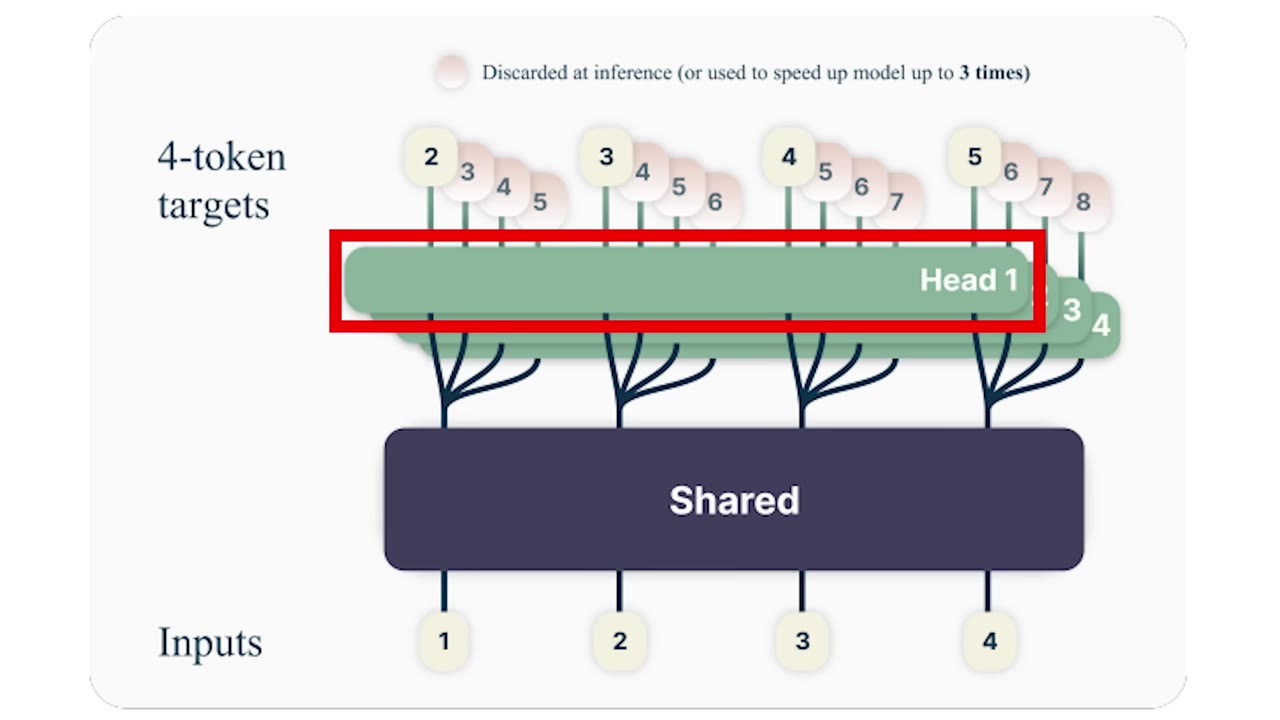
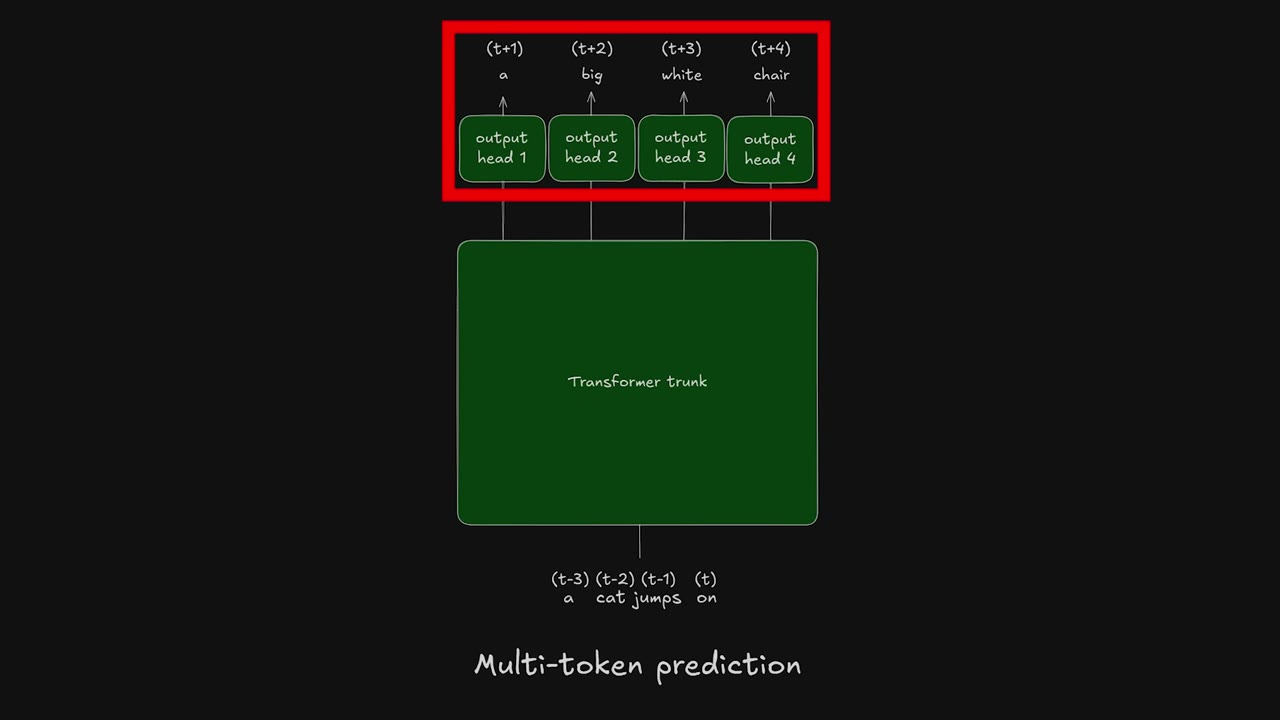
- Multi-token prediction (MTP) predicts t+1 through t+4 at once via a shared transformer trunk plus several output heads — up to 4x faster on paper.
- Naively it hurts quality, but trained jointly it boosts structure and syntax: coding +1.7–4.5% on the largest model, the ARC benchmark improves the more tokens you predict, and you keep a 3–4x speedup. It works because models already build implicit foresight (one hidden state predicts t+2 at ~48% accuracy), and bigger models have more room for it.
- DeepSeek V3's twist: use MTP as a training objective and discard it at inference, with sequential modules instead of parallel heads so the causal chain holds and the gradients enrich the shared trunk.
- Payoff: across 15.7B and 228.7B-parameter models, MTP-trained beats baseline almost across the board with little overhead — and keeping one MTP module for speculative decoding gives a 1.8x speedup at an 85–90% acceptance rate.
01 · The flaw in next-token prediction
It can't see its own future
Ask a non-reasoning model how many words its next sentence will have and it'll usually miss — not because it can't count, but because predicting one token at a time, left to right, makes it bad at anticipating its own output. That's the core weakness of the next-token paradigm. There are alternatives — diffusion language models fill a whole window at once, so every token gets a say, not just the ones already on the left; BERT attends in both directions — but both are big architectural leaps, and next-token prediction is already so well engineered they struggle to catch up. So here's the cheaper question: what if you just predict the next two, three, or four tokens at once?

02 · Multi-token prediction
Shotgun the next few tokens
MTP is what it sounds like: instead of only predicting token t+1 from the context up to t, also predict t+2, t+3, and t+4 simultaneously. The first version (proposed about a year ago) is architecturally boring in a good way — a standard transformer "trunk" processes the input into one hidden state, and instead of a single output head you add several independent heads, each predicting a future position in parallel off that same shared state.
03 · Doesn't that wreck precision?
The weatherman fix
Predicting four tokens blind sounds like it should make everything sloppier, and naively it does — the research says quality degrades badly. bycloud's framing: it's four weather forecasters each predicting a different day with no communication. But train them together and it's more like they all went through the same school, so their predictions don't drift far apart.

04 · Why it works
Models already have foresight
It's not a fluke. Researchers found that a single hidden state at position T already carries enough to approximate the t+2 token at about 48% accuracy. So even a model trained only on next-token prediction is implicitly building some foresight — MTP just makes it explicit and rewards it. That also explains why bigger models gain more from MTP: they have the internal room to build the foresight it promotes.
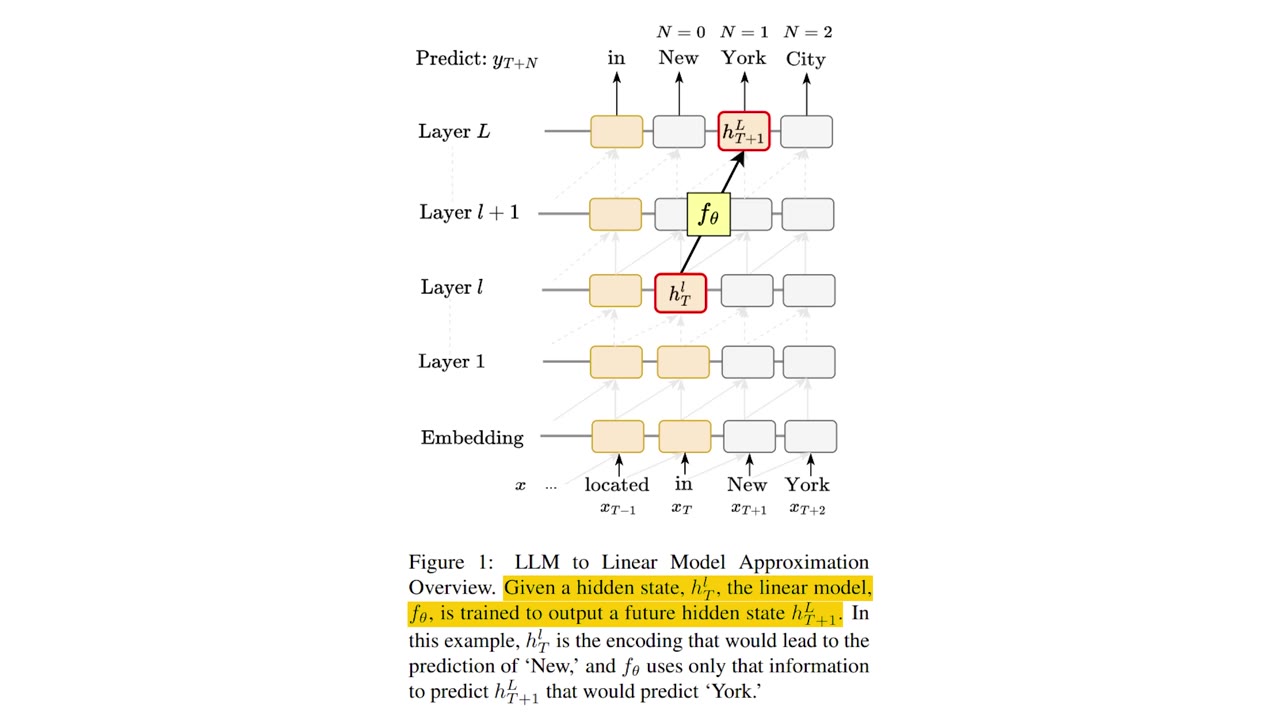
Even if a model is only trained to predict the next token, their internal hidden states would still implicitly force the model to develop some level of foresight.— bycloud
05 · DeepSeek V3's twist
MTP as a training objective
So why haven't the big labs shipped it? They have — the current best open-source model, DeepSeek V3, just buried it under everything else it does. Its insight is to flip MTP from an inference-time prediction trick into a training objective, then drop it at inference (the deployed model does plain next-token prediction). And instead of the inconsistent parallel heads, it uses sequential MTP modules so information flows from the t+1 prediction into the t+2 one — one extra transformer block per extra token, reusing the main model's output head.
The key is that the gradients from the MTP modules don't just train the extra blocks; they flow back through the shared trunk and output head, forcing the core model to learn richer, longer-range representations.
06 · Does it pay off?
Ablations and a free speedup
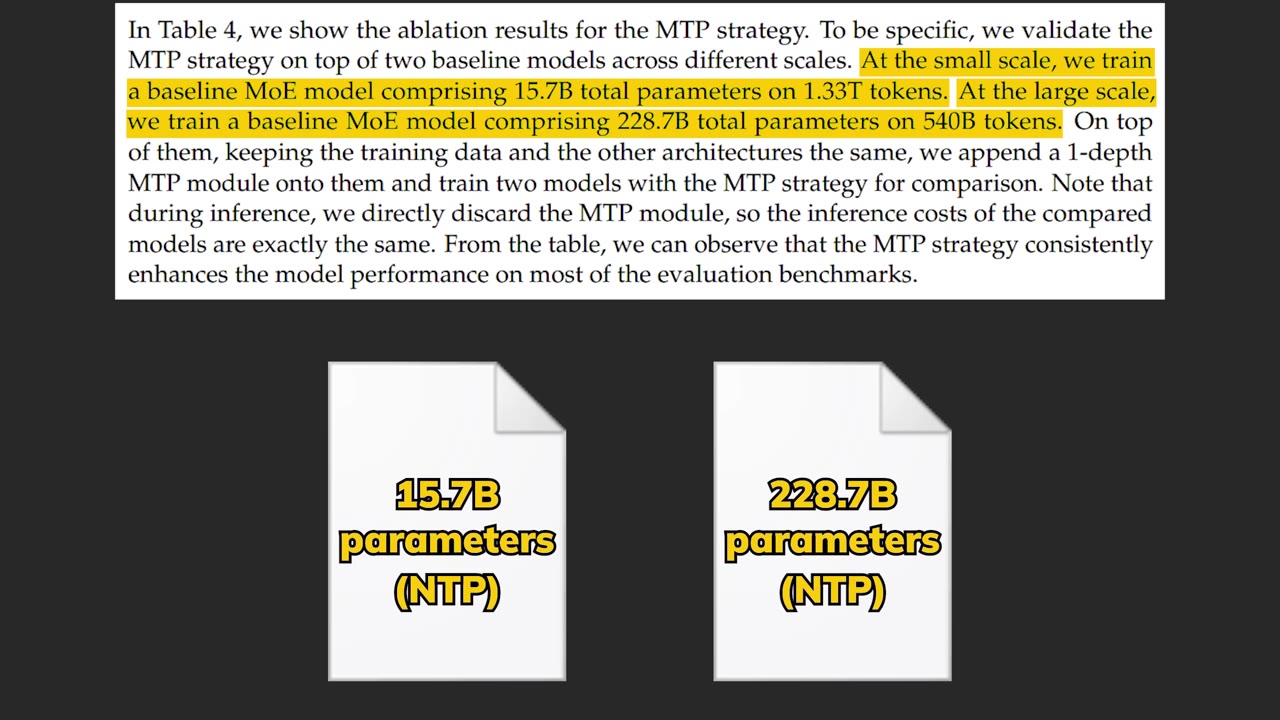
DeepSeek validated it carefully: 15.7B and 228.7B-parameter models, baseline next-token training versus the same models trained with one MTP objective (then discarded). The MTP-trained versions won almost across the board, with barely any added compute.
The cherry on top: keep that one MTP module around at inference and use it for speculative decoding — predicting two tokens at once — and you get a 1.8x tokens-per-second speedup, with the second token accepted 85–90% of the time. It takes the best of multi-token prediction while sidestepping the parallel-head pitfalls.