How a 5x Founder Runs His Startup Solo with AI Agents
Ryan Carson raised a $2M seed and isn't hiring anyone — he's running the company with a fleet of AI agents (OpenClaw, Codex, Devin). He walks through the actual setup, file by file: a chief-of-staff agent he calls R2, a "code factory" shipping 10+ PRs a day, and a marketing machine that runs itself. His point throughout: the new founder skill is building the system that does the work.
Creator: Peter YangRuntime: 39 minVideo published: May 24, 20266.7K views when summarized
The whole thing with agents is cron jobs and markdown files. Give one a good cron and a good skill file and it does a lot — Carson ships 10+ PRs a day and says agents are a million times easier to onboard than humans.
The startup advice flipped: you used to do the bare minimum to ship the MVP and skip docs. Now you invest heavily up front in docs, skills, and crons — and you're unlocked to do the work of 10 people.
His OpenClaw ('R2') runs as a chief of staff: 15-minute inbox/calendar sweeps, Slack pings, meeting booking, and daily cold outreach that's already landed 10–20 meetings. He treats it like an employee — its own email, GitHub, and calendar access.
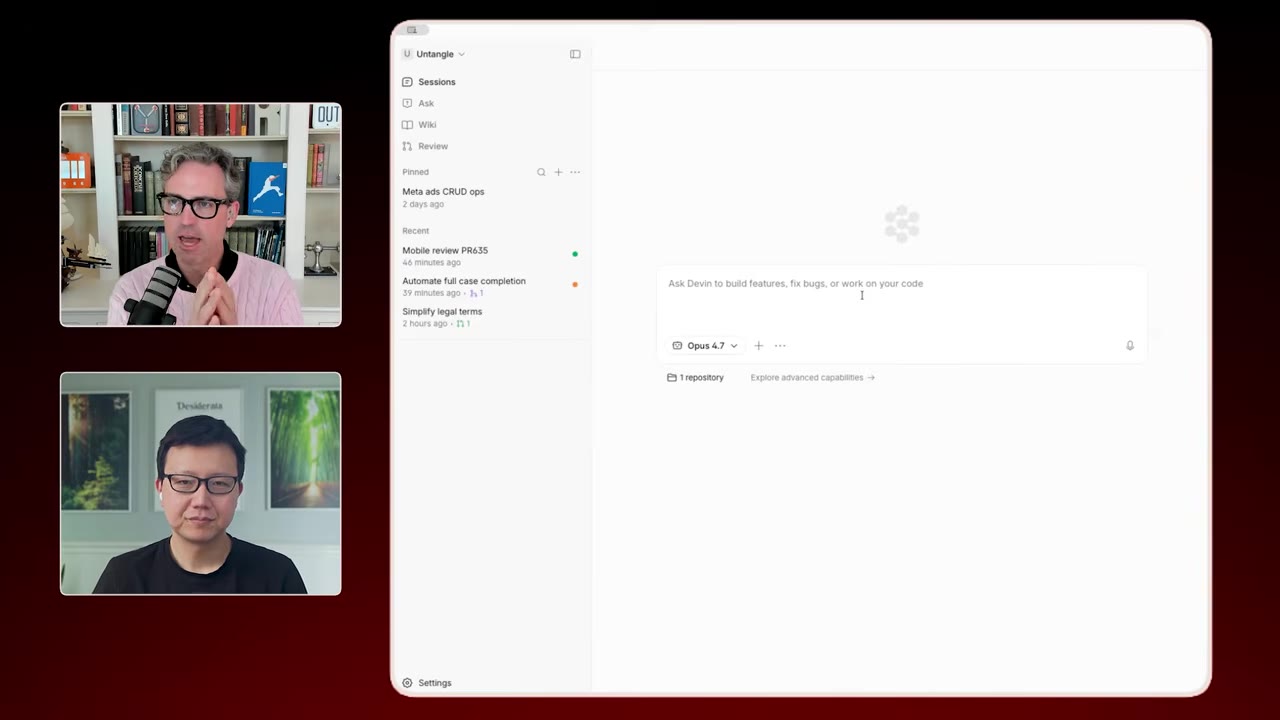
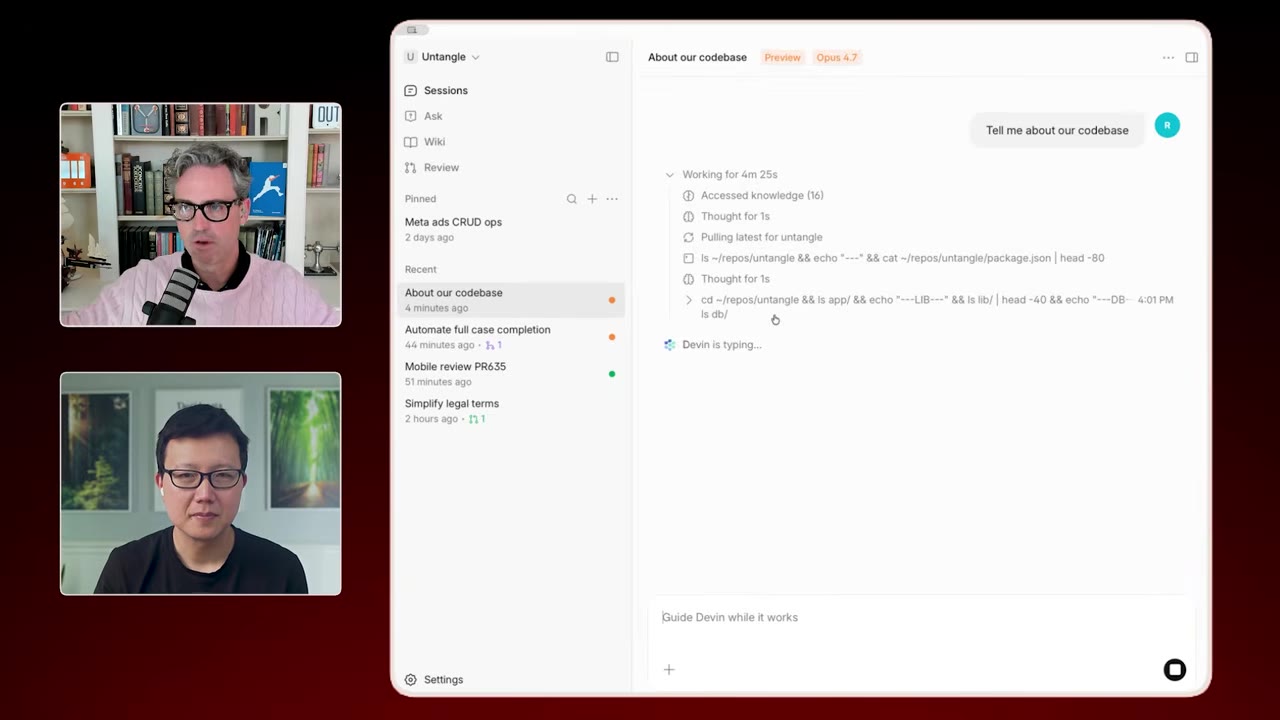
All his engineering runs in the cloud on Devin — no local dev. It's a PR-driven code factory where agents write, review, and ship ~100% of the code, so even a solo founder needs a big-team SDLC (a 'land PR' playbook merges without him).
Building features is trivial now; go-to-market is the skill. A machine handles Google Ads (a CLI Devin built itself), content (interview → 60-second clips → Gemini → OpenAI image model → Publer), and brand-consistent design from reference images — replacing a $6k/month designer after the first cut.
01 · The core idea
Agents are cron jobs and markdown files
The whole thing fits in one line: an agent is a cron (a schedule) plus a skill (a markdown file). Give it a good one of each and it does a lot. Carson is also blunt that this stuff is still hard to use — anyone claiming they waved a wand and OpenClaw changed their whole business isn't being straight with you.
"The big thing everybody needs to remember about agents is that they are cron jobs and markdown files."00:00:00
The reversalStartups used to say: do the bare minimum to ship the MVP, don't waste time on systems or docs. It's literally the reverse now. You spend the time up front on your SDLC, documentation, reference images, crons, and skill files — and then you're unlocked, doing the work of 10 people. The setup is brutal; the payoff is the leverage.
02 · R2, the chief of staff
OpenClaw as an EA
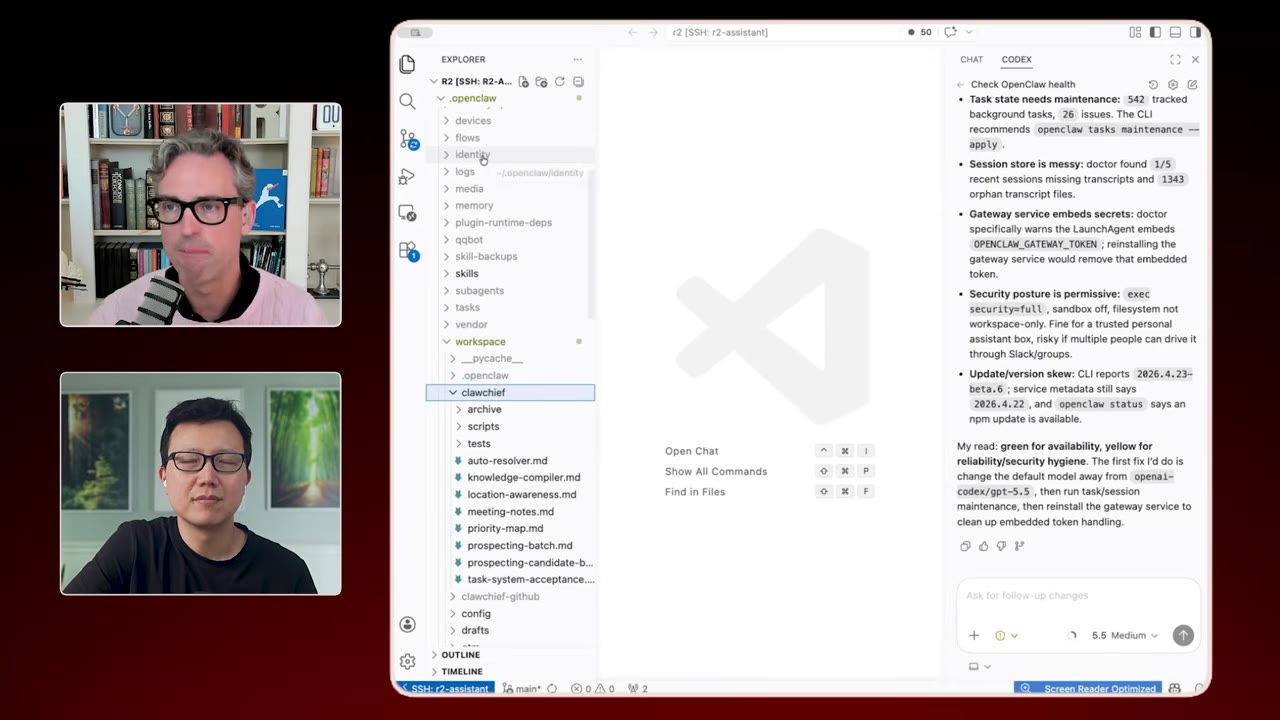
Carson has had real human EAs before, and the goal was to turn his OpenClaw — "R2" — into one. The setup is open-sourced as Claw Chief: a set of markdown files and some crons, that's basically it. R2 schedules meetings and parses Calendly links, sweeps his inbox, calendar, and priorities every 15 minutes and pings Slack, follows up on emails that didn't get a reply, and does business-development research.
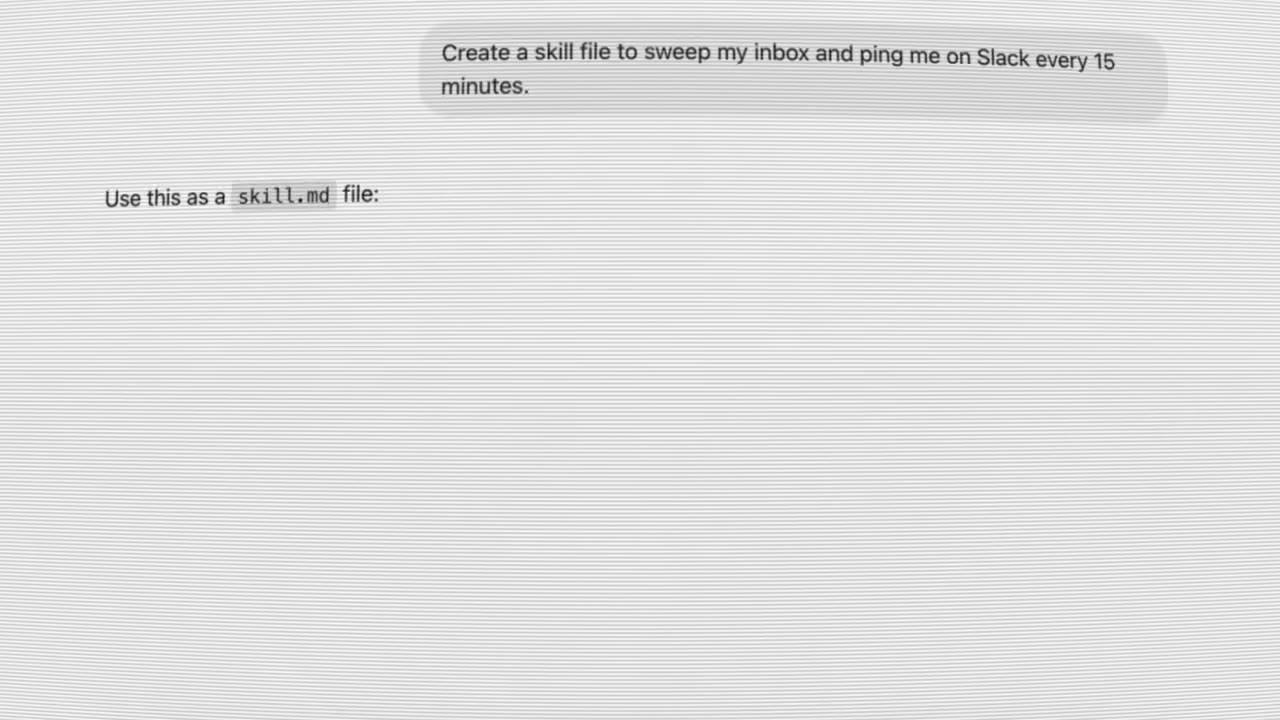
The unit of work: a skill file. "Create a skill file to sweep my inbox and ping me on Slack every 15 minutes." A priority-map file tells R2 the projects and people that matter so it can make good calls.00:00:30
03 · Crons over heartbeats
Treat the agent like an employee
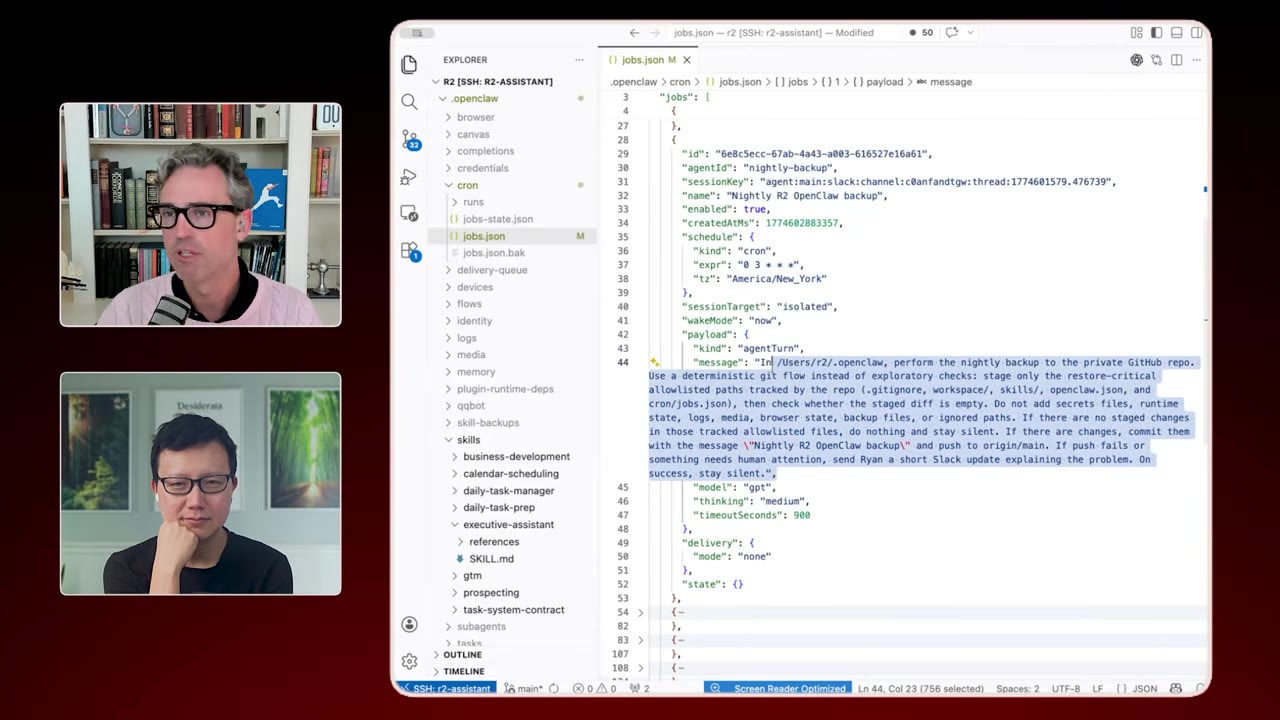
Use crons, not heartbeats. A heartbeat is OpenClaw saying "whenever I think about it, I should do this" — Carson found it unreliable. A cron is deterministic and repeatable: every 15 minutes, run this skill. Keep it DRY, too — don't stuff a big message in the cron that just repeats the skill.
He manages R2 from VS Code, SSH'd through Tailscale into a MacBook Pro that lives in his closet. The pro tip: he cloned OpenClaw's own repo so Codex can pull the latest source and figure out how to fix the agent when it breaks — which matters when the machine is across the world and you can't walk over to it.00:03:34
R2 gets treated like a real hire: its own email address on his domain, its own GitHub account, read access to his inbox, and write access to his calendar as itself. So the invite comes from R2 with Ryan added as an attendee — exactly what a human EA would do.
04 · The prospecting machine
Cold outreach on autopilot
A skill runs once a day, finds family-law attorneys and mediators on LinkedIn, and enriches them with Firecrawl — Carson swapped out the Brave search OpenClaw pushes you toward because it isn't very good; $20/month for a good agent-search API is worth it. It drops the prospects into a Google Sheet he uses as a CRM, drafts a cold email, and sends it as him from ryancarson.com (a 25-year-old domain, so deliverability is solid).
The prospecting skill in his editor. It's already booked 10–20 cold-outreach meetings in a couple of weeks. The catch: you have to be pedantic in the markdown — "always check if you've emailed them before" — because the agent follows your instructions literally. Set up the system once and you never have to say it again.00:16:54
05 · Devin & cloud engineering
No more local dev
For building, Carson uses Devin, and the thing that matters is it's cloud-only — it spins up a perfectly configured production VM, so he never has to fight ports, out-of-date dependencies, or a weird Homebrew conflict on his local machine. People tried Devin a year or two ago and it wasn't good; now it's freaking amazing.
His bet: most serious people move to cloud engineering and rarely, if ever, code locally again. Devin's browser testing just works — the agent runs the real app in its own cloud browser, reliably and deterministically.00:24:42
Don't over-build your toolsThe temptation, now that building is easy, is to ditch OpenClaw and build your own harness exactly how you want it. But then you end up maintaining it instead of working. So Carson sticks with out-of-the-box OpenClaw plus custom skills and crons. Endlessly switching agents to optimize them "makes good YouTube videos but it's not real work" — buy a couple of power tools off the shelf, don't build the whole machine.
06 · The code factory
PRs, even as a solo founder
If you want a code factory — agents writing, reviewing, and shipping as close to 100% of the code as possible — you need a software development life cycle that feels designed for a very large team. Agents are just like humans: they need reproducible processes that don't rely on you. PRs are key to that.
Everything is a PR. A "land PR" playbook tells Devin exactly how to review, resolve, and merge without him. Carson runs it 10–20 times a day and barely reads code anymore — he reads the PRs, and more than that, the markdown and what the agent is telling him about the work.00:28:58
A feature, end to end: brain-dump into the thread with WhisperFlow → "help me make a PRD," a skill that mostly just gets the agent to ask him clarifying questions → write the PRD as a markdown file → "build it" → walk away for 10–20 minutes → Devin browser-tests, screencasts, notices problems in its own PR and fixes them → land it.
07 · The marketing machine
Where the real work moved
Building features is almost trivial now — the real problem is how you get users and build revenue. So Carson automated go-to-market too. He had Devin build itself a CLI for the Google Ads API, with full upsert (insert, update, delete any campaign). Now he just chats with it every day about how the campaign is doing and how to optimize it, and never touches the Google Ads UI — the agent handles the complexity you used to hire an agency for.
The content engine: interview an expert in Descript → chop it into 60-second clips → upload the MP4s to Google Drive → a nightly Devin playbook calls Gemini to watch each video and write the copy, OpenAI's image model to make a branded cover, and Publer to publish to social.00:35:00
Brand consistency comes from a design.md plus reference images. He paid a designer (Brett from Design Joy, about $6k/month) for the first cut of the branding and social images — you still need a good designer's taste for that — and now the OpenAI image model reproduces the brand for unlimited free imagery.
08 · The takeaway
Build the system, then everyone's a founder
The work now is setting up the system that does the work. Take the time to do that and two things happen: you understand how the work actually happens and you refine it, and then you either bring on more agents or bring on a human who's augmented with agents. The whole point of staying solo for now is to feel every job before you hire to fill it.
Carson built Untangle's MVP in his free time before raising, so the product's basically done and it's all go-to-market from here. His point: companies used to bifurcate into product people and marketing people, and you can't do that anymore. Building is almost trivial, so go-to-market, adoption, and product-led growth are the skill. "Everybody is a founder now, even if you're not."00:38:00