Agentic LLMs: RAG, Tool Calling, and Agents (Stanford CME295, Lecture 7)
A trained LLM only knows what was in its data and can only talk back at you. This lecture is about closing both gaps — connecting it to current knowledge with RAG, and letting it act through tool calling and agents. It builds up in order, with a running teddy-bear example, from retrieval to the ReAct loop to multi-agent systems and safety.
Watch on YouTubeThe lecture in one pass
- Two limits of a trained LLM: it only knows its training data (fixed at a cutoff), and on its own it can only produce text. RAG fixes the first; tools and agents fix the second.
- RAG = retrieve, augment, generate. The hard part is retrieval: chunk your documents, embed them, then retrieve in two stages — fast candidate retrieval (semantic embeddings, optionally keyword BM25) then a heavier cross-encoder reranking — measured with NDCG, MRR, precision@k, recall@k.
- Tool (function) calling is a three-stage loop: the LLM fills a documented function's arguments, you run the function, then the LLM turns the structured result into a natural answer. You can teach it with SFT pairs — or skip SFT and iterate a prompt explanation against an eval set.
- Scaling tools: a tool-selector/router narrows a huge tool list to the few relevant ones; MCP (Anthropic) standardizes how tools are exposed so you don't reimplement them per model.
- An agent adds reasoning loops on top of tools. ReAct = observe → plan → act, repeated until the goal is met. Multiple agents can coordinate (Google's agent-to-agent protocol) — which raises real safety risks like data exfiltration, handled at training and inference time.
01 · Why connect an LLM to anything
The cutoff problem
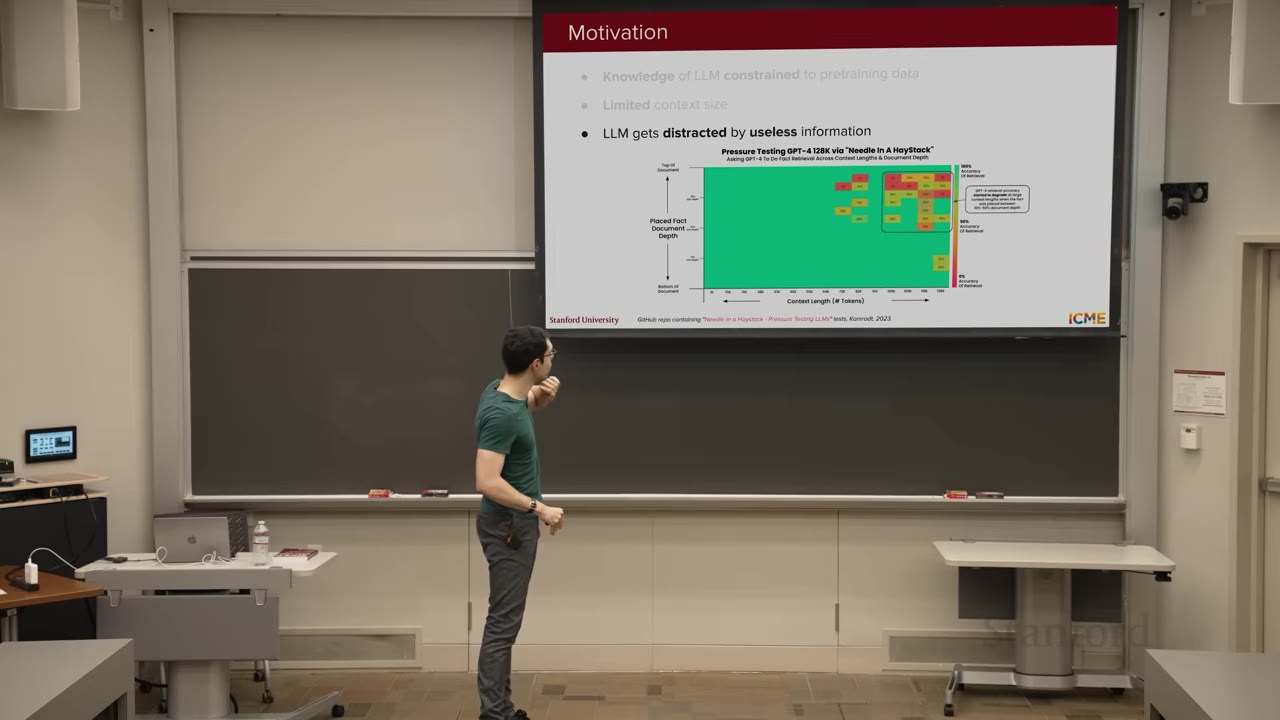
A trained model only knows what was in its data, frozen at a knowledge cutoff (GPT-5's, for instance, is September 2024). Retraining to add knowledge is risky and impractical, and you can't just dump everything into the prompt: context windows are finite (~hundreds of thousands of tokens), you pay per token, and performance actually drops when the prompt is stuffed with irrelevant text.
02 · RAG
Retrieve, augment, generate
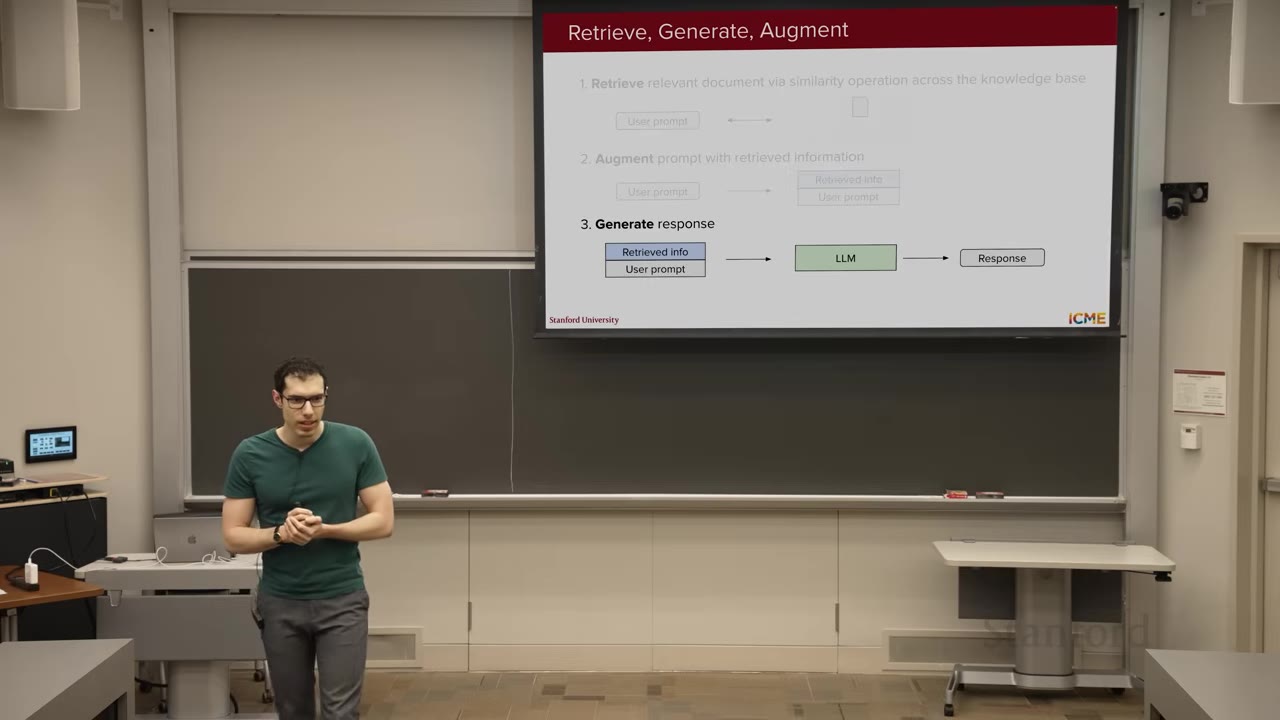
The fix is to put only the relevant information in the prompt. That's RAG: retrieve the relevant documents for a query, augment the prompt with them, then generate the answer. In effect you're handing the model the answer inside the prompt — so the whole technique lives or dies on the retrieval step.
03 · The knowledge base
Chunks, embeddings, overlap
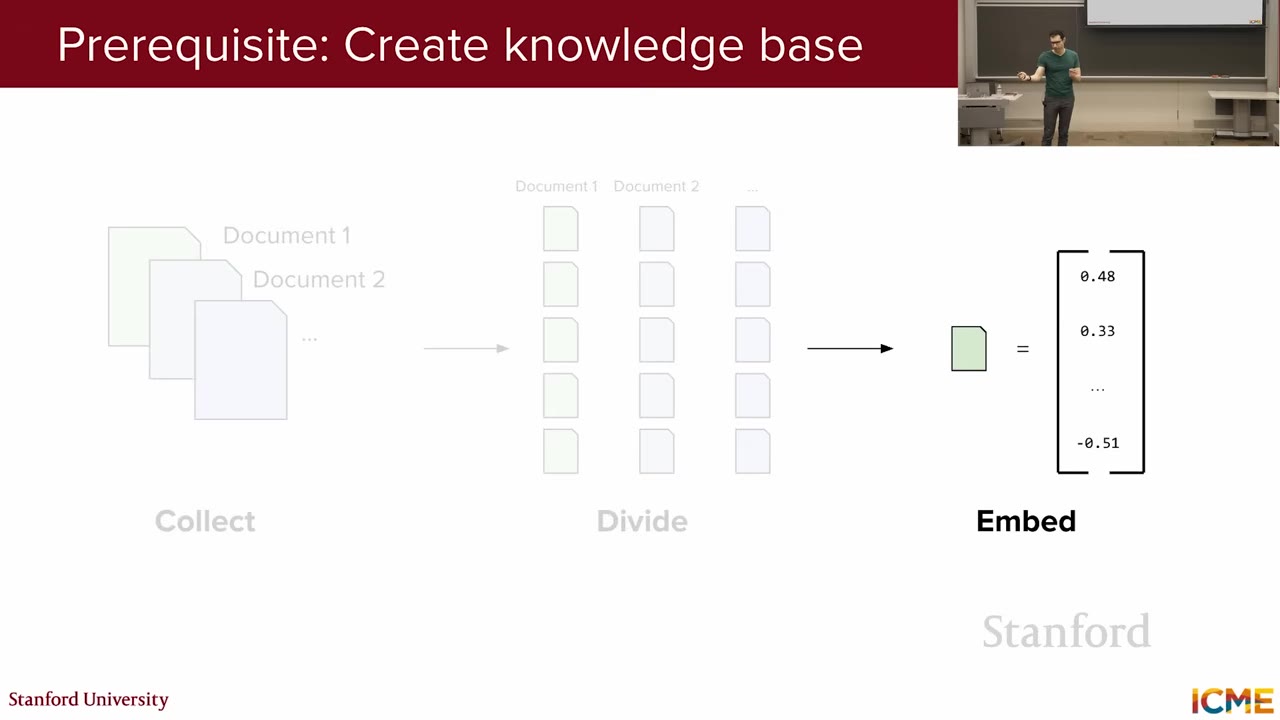
Before you can retrieve, you build a knowledge base: collect the documents, split them into chunks (a few hundred tokens each), and compute an embedding for each chunk. Three knobs to tune: embedding size (≈ thousands of dimensions; bigger captures nuance but costs space and compute), chunk size (too small loses context, too large blurs meaning), and overlap between chunks (so a chunk keeps the context of the one before it).
04 · Retrieval in two stages
Candidate retrieval, then ranking
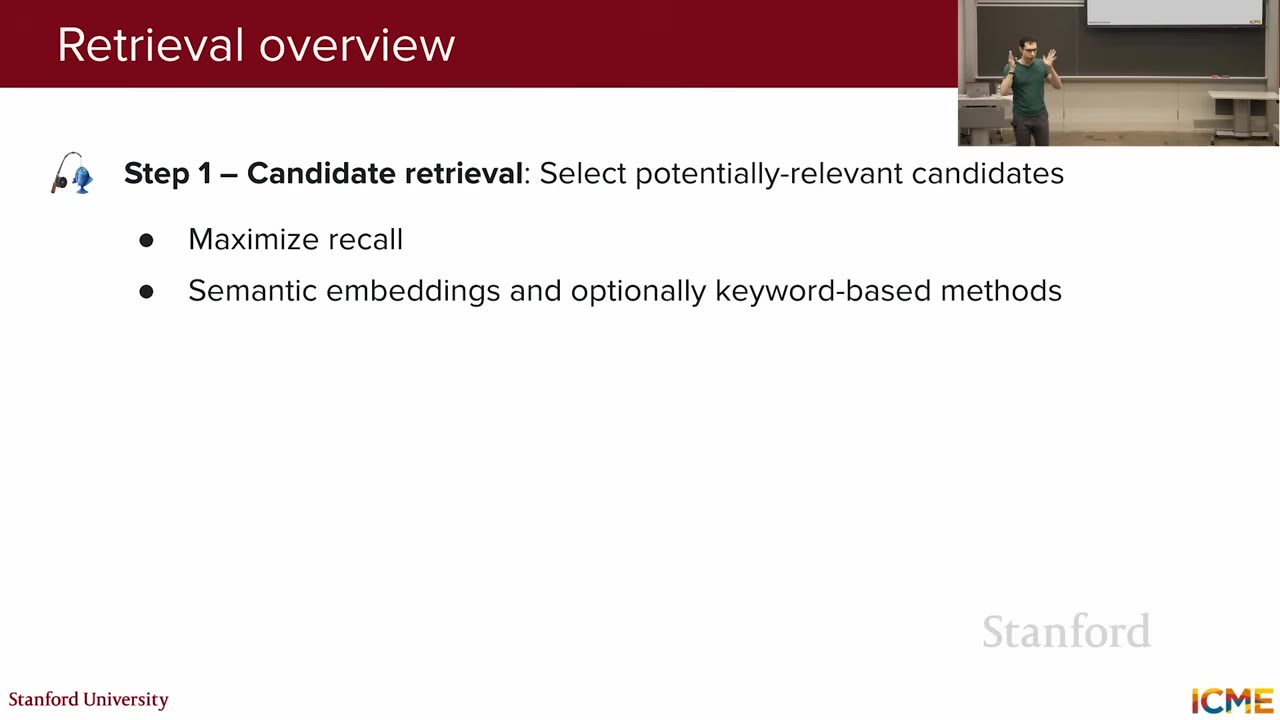
Retrieval borrows the recommender-systems playbook: two stages. Candidate retrieval quickly narrows millions of chunks to ~100 by embedding the query and doing a cosine-similarity search (using approximate-nearest-neighbor methods to avoid a linear scan). Because query and chunks are embedded separately, this is a bi-encoder setup, and the goal here is recall — cast a wide net.
05 · Semantic vs. keyword
BM25 and hybrid search
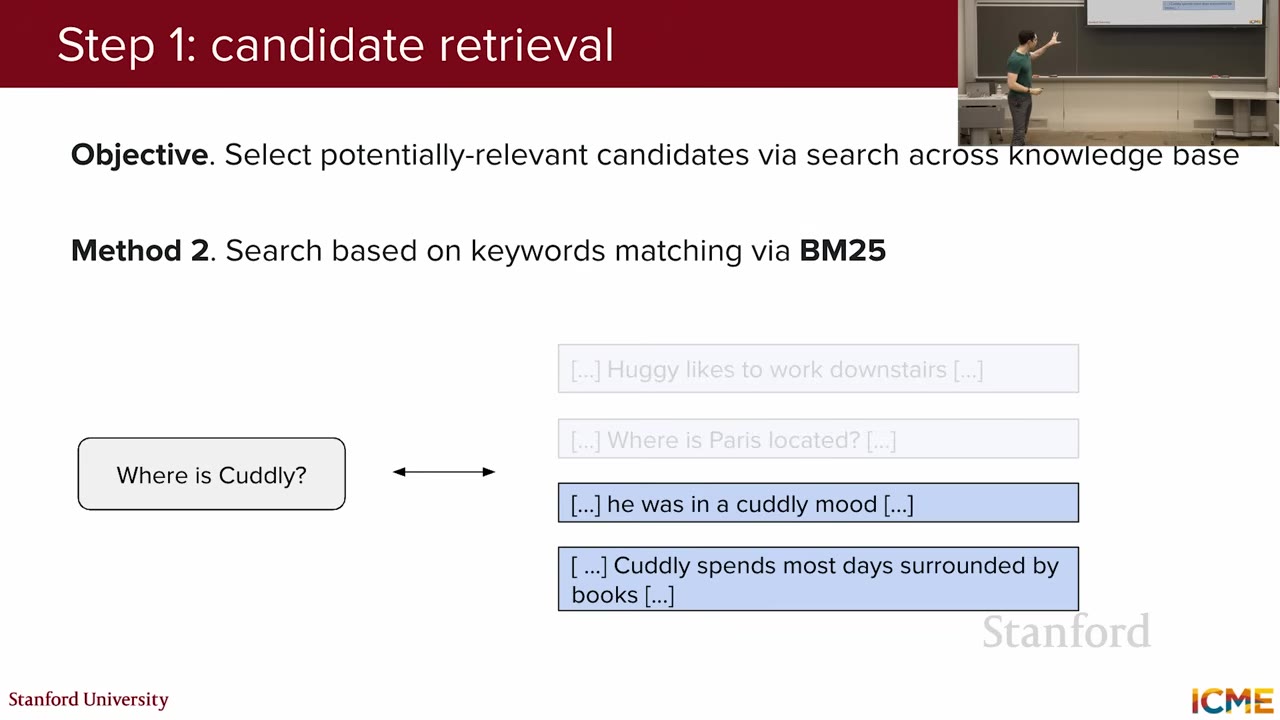
Embedding search finds chunks that mean the same thing — but it won't guarantee the exact keyword is present. When you need that (searching for "Cuddly," not just something cuddly-adjacent like "Huggy"), BM25 is a heuristic score based on word overlap between query and document. Many systems run a hybrid of embedding search plus BM25.
06 · Smarter chunks, cheaper calls
Contextualization + prompt caching
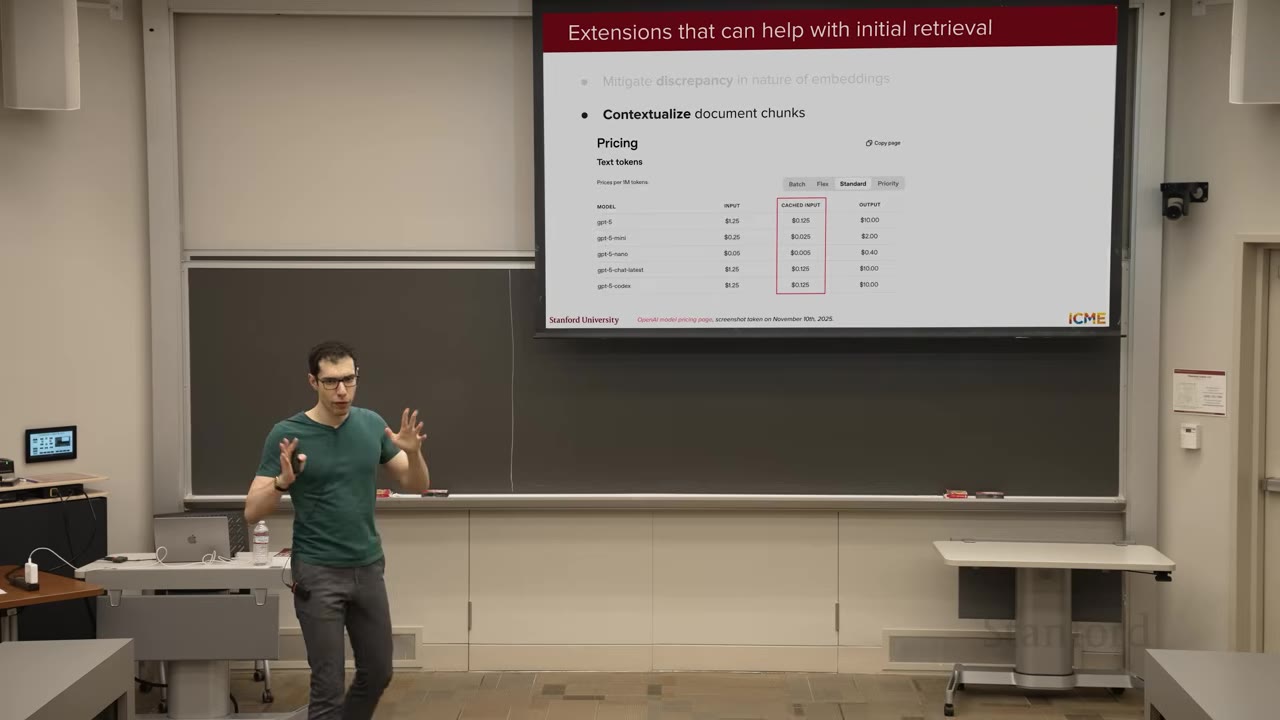
Chunks cut at a fixed token count can lose their meaning out of context. Contextual retrieval prepends a short, LLM-written summary of what you need to know to understand each chunk — based on the whole document. That's a lot of LLM calls, so it leans on prompt caching: reuse the same prefix across prompts and you compute its activations once, then look them up.
07 · Reranking and metrics
Did retrieval actually work?
The optional second stage is reranking: instead of comparing pre-computed embeddings, feed the query and a candidate chunk together into the model (a cross-encoder) so attention can capture their interaction, and score relevance directly. It's heavier, but you only run it on the ~100 candidates. Then you measure.
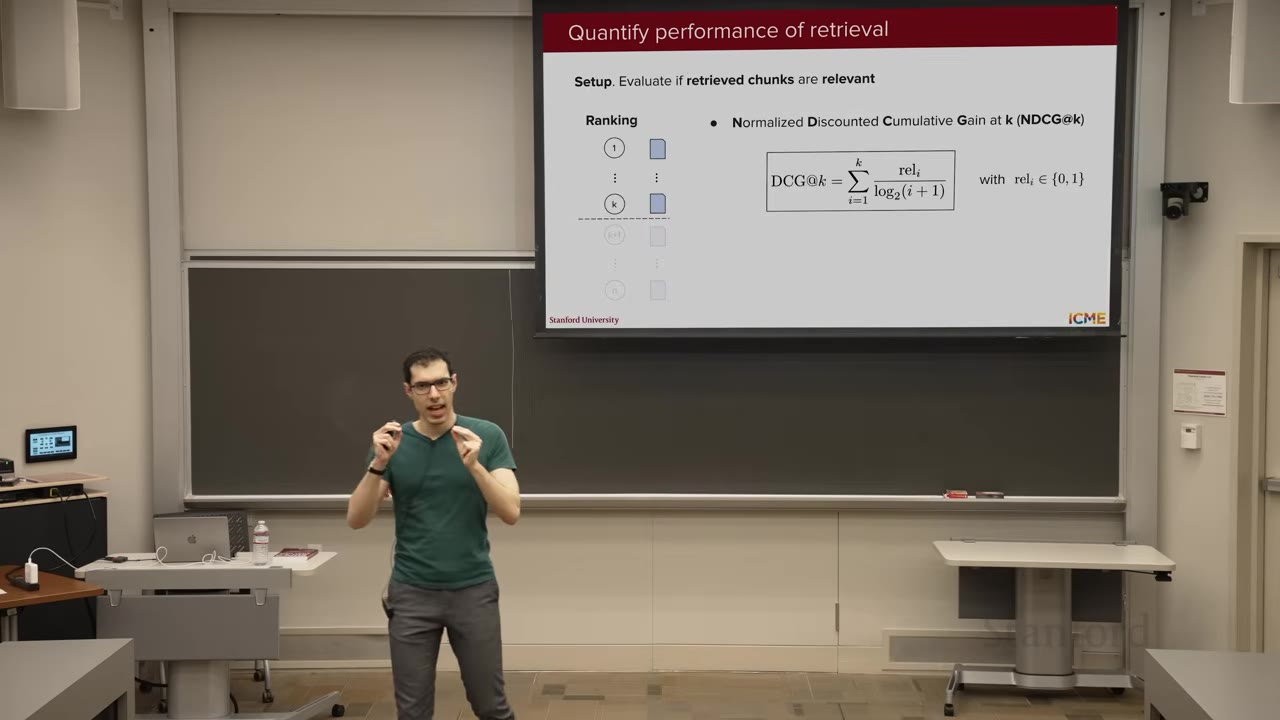
NDCG
ranking quality, weighted toward the top, normalized to [0,1]
MRR
inverse rank of the first relevant result
Precision@k / Recall@k
the classic metrics, over your top-k
MTEB
a standard benchmark to compare retrievers
08 · Tool calling
A three-stage loop
Where RAG injects unstructured documents, tool (function) calling lets the LLM act through structured functions. You show the model a documented function — its name, arguments, and docstring, but not the implementation. The loop has three stages: the LLM picks the function and fills its arguments from your query; your code actually runs the function; then the LLM turns the structured result into a natural-language answer.
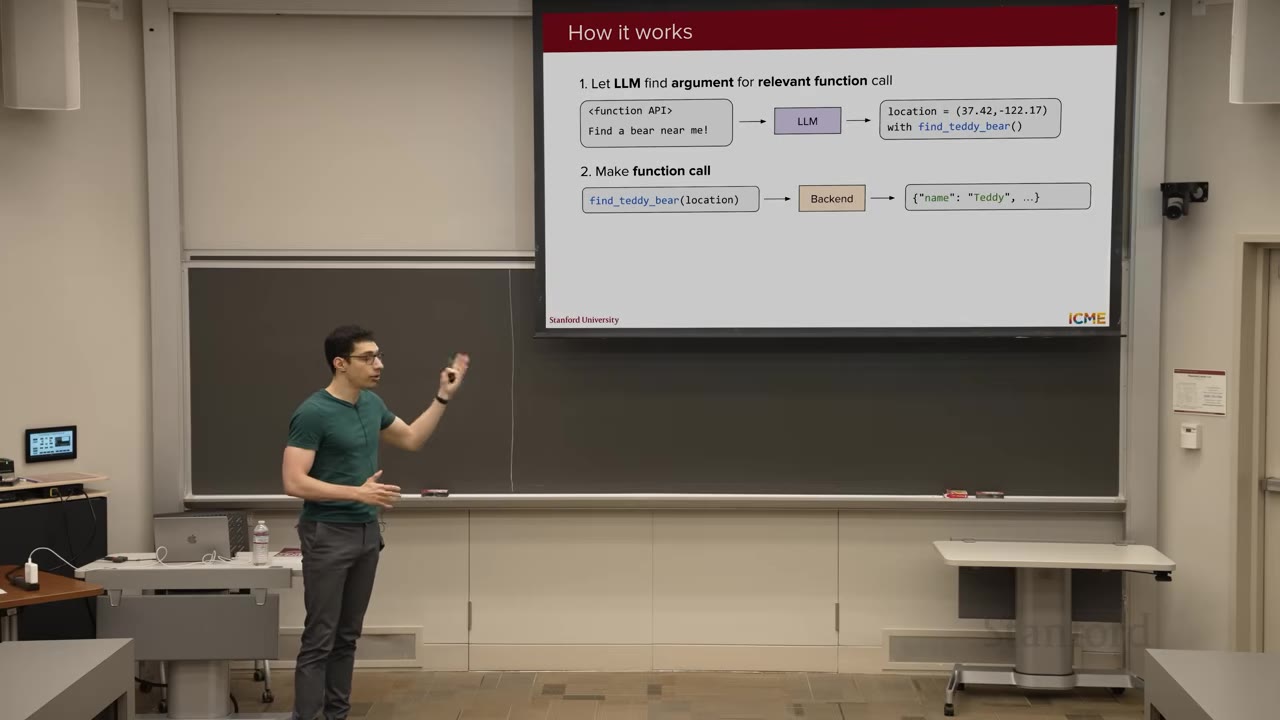
find_teddy_bear(location) calls an API, returns a structured object, and the model reads it back to you in words. Tools span information (search, weather, stocks), computation (run code), and actions (send an email — and hit send).01:10:2009 · Teaching a model to use a tool
SFT, or just an explanation
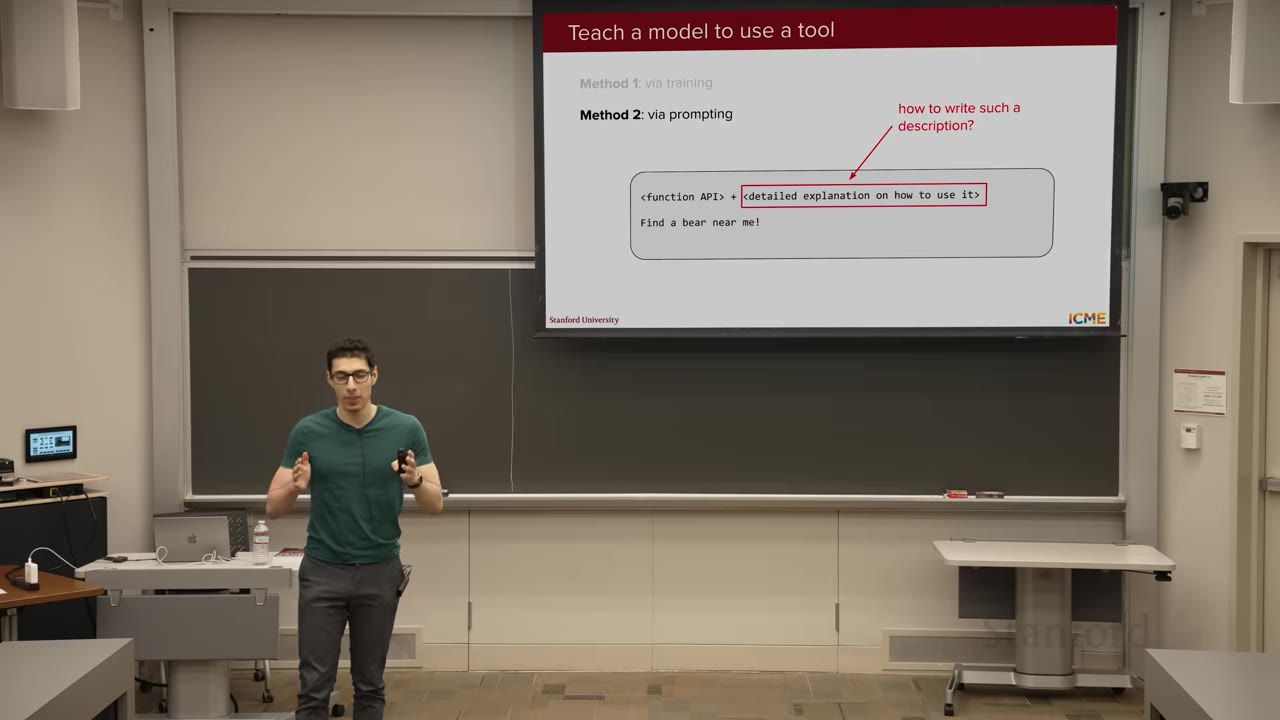
How do you get the model to do this? One way: two sets of SFT pairs — one mapping query → tool call, one mapping the tool's result (plus conversation history) → final answer. But modern models already read code well, so you can often skip SFT and just write a prompt explanation of the tool.
10 · Too many tools
Selection and MCP
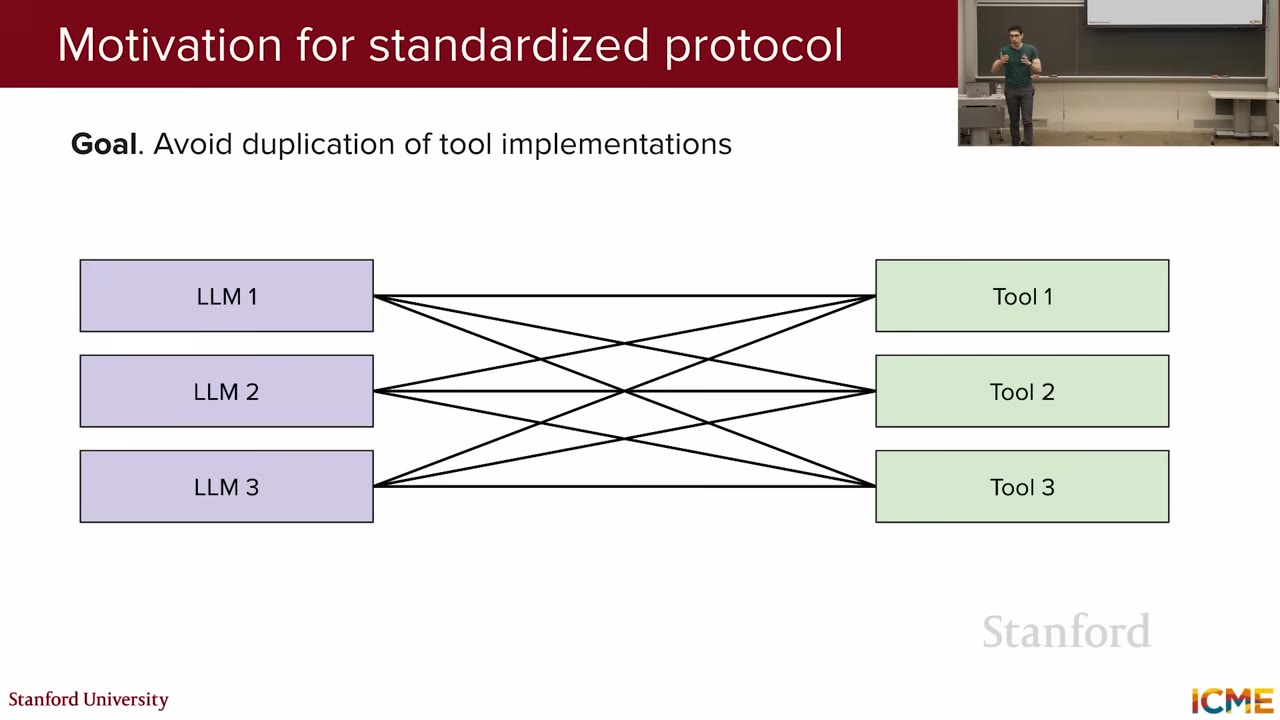
In practice you expose many tools, and a big tool list recreates the needle-in-a-haystack problem — plus context is finite, so you can't fit everyone's tools at once. A tool selector (or router) fixes the first: given the query and a list of tool names, an LLM picks the few relevant ones, and only those go into context. The second problem — every model defining tools its own way — is what MCP addresses.
11 · Agents
The ReAct loop
An agent sits one layer above tools: it autonomously pursues a goal, with reasoning loops, not just a single call. The hallmark is ReAct (reason + act), which decomposes a task into repeated stages — here framed as observe → plan → act.
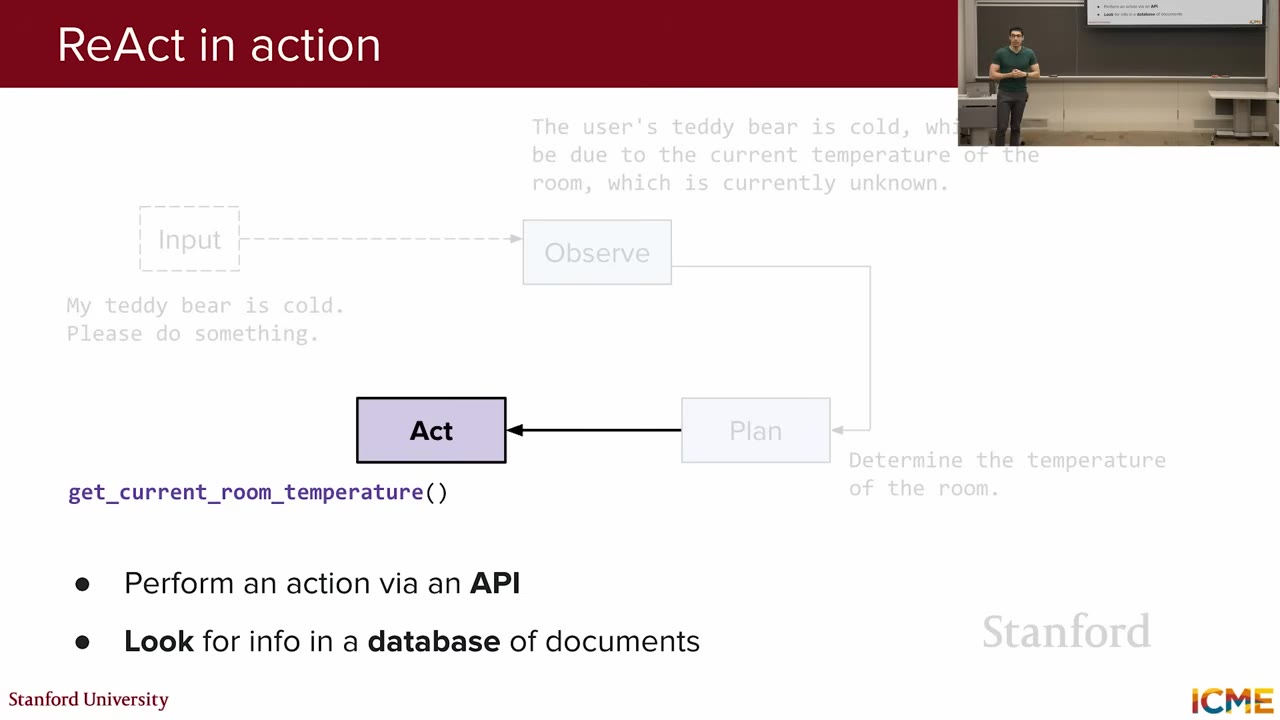
get_current_room_temperature(); observe reads 65°F as colder than expected; plan/act raise it — then the loop exits and answers the user.01:36:4012 · Many agents
The agent-to-agent protocol
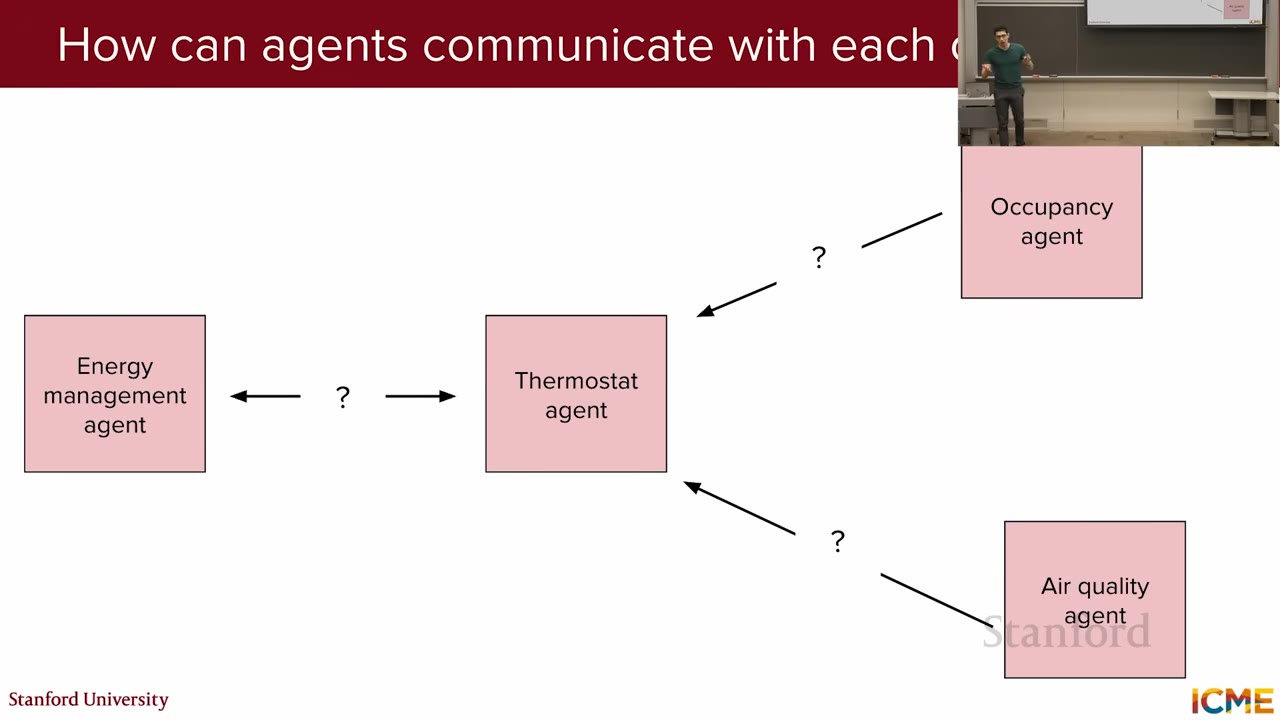
Once you have one agent, you can have several — a thermostat agent, an energy-management agent, an air-quality agent — and let them coordinate. That need for a common language between agents is why Google released the agent-to-agent (A2A) protocol: each agent exposes a set of skills (with examples), plus a defined way to execute a request, report status, and cancel.
13 · Safety, and how to build
Taste is what's left
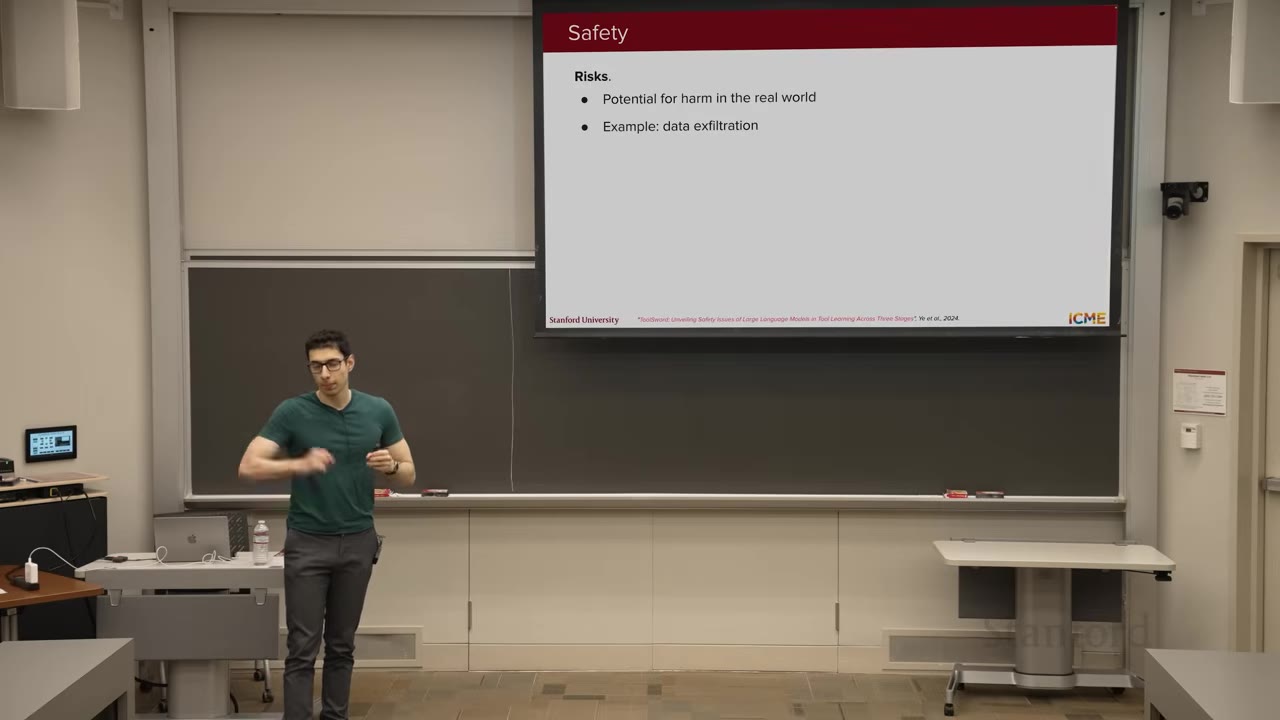
New power, new risks: a model that can act can be turned against you — e.g. data exfiltration, where a prompt makes an email tool send out a user's password. Defenses come at two points: training (safety data in the SFT/RL mix) and inference (a safety classifier judging the conversation). The lecture notes Anthropic's just-published report on a large-scale cyberattack that abused tool and agent capabilities — proof the stakes are real.
Generating code is cheap, but judging whether a code is correct and does the right thing — this is the hard part. Your taste is going to matter most from now on.— Shervine Amidi